Showing posts with label reviews. Show all posts

Friday, October 7, 2011

Jesus and the Jewish Roots of the Eucharist - Brant Pitre


Jesus and the Jewish Roots of the Eucharist by Brant Pitre

Rating: 6
Readability: 6
Impact: 6

Read it Again: No. Might refer to a few passages.
Recommend It: Not over other books on the same subject.

What to Expect

Observations on the Lord's Supper from the Old Testament and what we know of Jewish life from a Catholic perspective. 

Feels written by the rules (in good and bad ways), but with some big gaps in his arguments. Many of his observations are fascinating and true, but some of his approach and conclusions are puzzling.

Most of the book doesn't touch on specifically Roman Catholic doctrine. What is more startling and prevalent than he's brief passages and weak arguments directly on transubstantiation, is what he seems to say about Jesus.

Pitre focuses on Jesus divinity in several areas, but seems to imply in several others that Jesus didn't know what was going to happen to Him. His Christ seems not to know how His own life was written. This scared me. This topic, however, is so complicated and has so many definition arguments, it's hard to know what he's actually saying. 

There also seemed a big separation from spiritual and physical ideas and commands. Which, I guess makes sense along with other Roman Catholic beliefs, but I'd never thought about it that way before.

My Squib

Glad I read the book. The typology and historical aspects give some good food for thought. It is the first specifically Roman Catholic book I've read, and although there were several things I disagreed with, it was a good experience. 

You can get most of Brant Pitre's interesting bits plus a wider and more organized look at Lord's Supper throughout the Bible, from Dr. Leithart's book Blessed are the Hungry.

One thing the book accomplishes well is making one think about the Lord's Supper and it's importance. We should disagree with Rant Pitre on some points (and certainly the Roman Catholic Church), but we must seek to understand Communion. We should know what God teaches about this beautiful feast and strive to know what it means. 

Tuesday, August 23, 2011

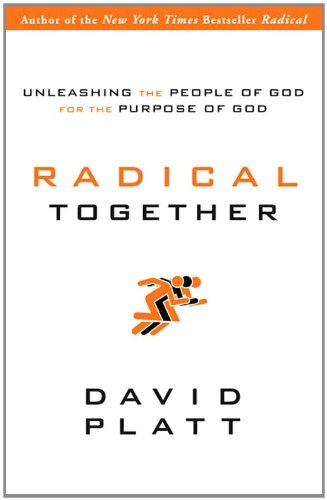
Radical Together - David Platt

Radical Together: Unleashing the People of God for the Purpose of God  by David Platt
Multnomah (2011)


Rating: 8
Readability: 8
Impact: 9


Read it Again: Yes.
Recommend It: Yes!


What to Expect

Pastor David Platt moves from his best selling book, Radical, focusing on our own ambitions and expectations, to Radical Together, a book that focuses on the position, responsibility, and power of a community of believers.

Radical Together is a call back to a Christ-centered vision for the Church--her energy, resources, and focus.

The book focuses on both home-based discipleship and missions abroad, in a manner modeled after the Gospel.

David Platt is direct and engaging. He doesn't smooth over the tough stuff. If you aren't prepared to be convicted or spend time in serious evaluation, don't read this book.


My Squib

Radical Together draws its arguments and conclusions from the character of God and the fallen state of Man. The Church is a body of sinful, messed up, complicated people...all wrong for this beautiful, momentous task, but together created for a weapon of victory.

We are called to be selfless followers of a self-centered God. He is not our slot machine. We are His servants. There is no greater joy than serving, glorifying, and enjoying Him as He has called us!

A book taking the Church this seriously is both refreshing and somewhat depressing... We've been doing a pretty rotten job.

Both of David Platt's books have given me a lot to think about and evaluate in my own priorities and attitudes. They are dangerous stuff. I'd love to talk to someone else who has read them and has another take.

They've been my book of choice to give away for 2011, but I guess I still haven't decided what I think on all their aspects. Time for a reread... If only there wasn't so much else to read too! ;-)

From the Book

"Are these steps radical in and of themselves? For some the answer has been yes. For others, the answer has been no. But for all, the aim has been to set our lives and our churches in motion by putting ourselves in positions where God can mold our hearts with his gracious Word for his glorious purpose."

Monday, April 11, 2011

God Is - by Doug Wilson


God Is: How Christianity Explains Everything by Douglas Wilson


A reply to Christopher Hitchens' God is not Great: How Religion Poisons Everything


A short, chapter-by-chapter response to Hitchens' book before their debates shown in Collision. It's an interesting look into organized thinking and gentlemanly, but firm, intense debate. ;-) It includes some good laughs...

Doug Wilson's responses are good for some mulling over, not just for arguing with an atheist. This portion really stuck with me--

"Sinners are guilty and all sinners must die. What the cross does is provide us with a way of dying, with resurrection as a promised consequence. Jesus did not die so that we might live. He died so that we might die; He lived so that we might live. This is our hope, and this is our glory. And God in His kindness has authorized His people to extend this offer--full of grace--to people like Christopher Hitchens."

Thanks for reading,
Miss Pickwickian

Monday, March 21, 2011

Write. Even when it hurts.


"Write"
Necklace by Bookish Charm

The last two weeks have been hectic, but I have just enjoyed a complete day at home. It was marvelous. :-)

I need to rethink my schedule. I need to get more writing time in. There are always those days of insanity or simple exhaustion when there isn't time or energy to write. Lately they seem to be stacking on top of each other and it's hard to make much progress. I think I need to make myself write anyways...even when there isn't time or brain power.

Is the only solution sleep deprivation?
Is it possible to write and not be a zombie? ;-)

Over the next few days I really need to hash this out. How am I going to make this happen? Hopefully you'll see some encouraging posts on this topic soon.

In the mean time...Visit Bookish Charm. :-)

This is a wonderful shop that you will probably fall in love with if you are a word nut.
I have her amazing "Write" necklace (pictured above). I'm contemplating wearing it 24/7 as a reminder. ;-) It's strong, but beautiful looking. At first I was worried it would be to big for me. I'm into smaller, more delicate jewelry, but it isn't too big at all. I like to hang it where I can see it, if I'm not wearing it. ;-)

Some new additions to Bookish Charm have recently caught my eye (like these-- "Not all who wonder are lost" and "All the World's a Stage...").

I will be hosting a giveaway of this inkwell necklace along with a $15 giftcard starting later this week!

Thanks for reading,
Miss Pickwickian

Friday, March 11, 2011

The Four - Peter J. Leithart


The Four: A Survey of the Gospels by Peter. J. Leithart
Canon Press 2010

Rating: 9
Readability: 8
Some of it might seem a bit slow when he's getting into scholars arguments on dating etc... Why can't biblical scholars just believe the Bible? Most of it is extremely interesting and it continues to get more and more exciting as the book progresses.
Impact: Very high, I hope.

Read it Again: Yes! Slower with my Bible, pen, and paper in hand.
Recommend it: Highly.


What to Expect

The Four is organized like A House for My Name with bite-sized portions followed by review and thought questions.

Leithart gives an excellent overview of what we commonly refer to as the "intertestamental period" and in the process, information on the prophets. He then dedicates a chapter to the four Gospels and how they relate and differ before going on to a full chapter on each individual book. As always his writing is clear and exciting and his Bible knowledge is staggering and inspiring.

My Squib

I have been so immersed in Old Testament books with this Ligonier course. This was really fun to read. I literally flipped out when I saw it was coming out last October. I'd just been griping that Leithart didn't have enough on the NT.

The introductory stuff on the history before the Gospels was especially good for me as I haven't heard much on that era. The way he pointed out the different thrusts of each book and how they related was excellent. I really felt like copying the whole book out in my "notes/quotes journal".

I had very high expectations and wasn't in the least disappointed. I only wish there was more...

From the Book

See this quote I posted earlier.

Okay...this is a long quote and I hope I'm not breaking any copyright laws, but this is simply awesome and should show you how much you need to read the book.. :-)

As Matthew tells the story, Israel's history is a story of a spurned husband who refuses to give up on His bride. His bride spurns Him and finds other husbands, but He woos her back. He is the relentless, pursuing Hound of Heaven.

That is the message of the final act of this romantic comedy. Yahweh comes in flesh; Israel's Father comes as Israel's Son, and He is rejected yet again. He is rejected more thoroughly than ever. Persecuting prophets is bad; killing God Himself is worse. But the resurrection shows that Israel's God will not let Israel have the final word. He will not let Israel's rejection stand. He keeps coming back, even after Israel thinks they have killed Him. Israel does her worst: Yahweh comes as man, and Israel kills Him. If this were not the gospel, it would be a horror story, because this God cannot be stopped, cannot be buried. He comes back, and back again, even from the grave.

This is the great good news, the unsettling gospel of God. Matthew's gospel reveals that God is love, and Matthew's gospel shows us what kind of love God is: He is relentless, faithful, persistent love.

Thanks for reading,
Miss Pickwickian

Wednesday, February 16, 2011

C.S. Lewis, Max McLean, and your affectionate Uncle Screwtape


As previously stated, I got to see The Screwtape Letters in Portland on Saturday. :-)
I am so blessed to have gone. I wish I could just round up people and drive them into the theater! It was absolutely amazing and really made you chew on some thought-provoking stuff.

Although I knew it was going to be good, I wasn't prepared for how entertaining it would be. It never let you get remotely bored. I just wish I could see it several more times because there is so much to take in and think about.

I've read The Screwtape Letters and listened to Focus on the Family's rendition (not as good as reading the book) but it was very different to see it acted/narrated. It was also interesting to see what they choose to keep in and what they had to cut out. I think they did a good job preserving it's C.S. Lewis-ness.

The music was amazing. The acting, lighting, props...all wonderful.

You can see an interesting interview with McLean here. You can also see his narration of Mark on Youtube.

A lot of portions really stuck out to me. Something about hearing things from the other direction really gives you a wakeup call.

Do not be deceived, Wormwood. Our cause is never more in danger than when a human, no longer desiring, but still intending, to do our Enemy's will, looks round upon a universe from which every trace of Him seems too have vanished, and asks why he has been forsaken, and still obeys.

In a week or two you will be making him doubt whether the first days of his Christianity were not, perhaps, a little excessive. Talk to him about 'moderation in all things'. If you can once get him to a point of thinking 'religion is all very well up to a point', you can feel quite happy about his soul. A moderate religion is as good for us as no religion at all--and more amusing.

What he says on friends and conforming or becoming a different person depending on who you are around....and therefore being disloyal to all sets of acquaintances and then only feeling vaguely self-satisfied, self-righteous, or just shameful was extremely interesting. The whole section is something I think a lot of us young people could do some studying on.

Indeed the safest road to Hell is the gradual one--the gentle slope, soft underfoot, without sudden turnings, without milestones, without signposts.


If this portion was in the play, I missed it. I need to include it though because it is something I need to hear.

The most alarming thing in your last account of the patient that he is making none of those confident resolutions which marked his original conversion. No more lavish promises of perpetual virtue, I gather; not even the expectation of an endowment of 'grace' for life, but only a hope for the daily and hourly pittance to meet the daily and hourly temptation! This is very bad.


Or do you not realize that the patient's death, at this moment, is precisely what you want to avoid? ...he will almost certainly be lost to us if he is killed tonight. This is so obvious that I am ashamed to write it...They, of course, do tend to regard death as the prime evil and survival as the greatest good. But that is because we have taught them to do so. Do not let us be infected by our own propaganda.

The portion that is in Chapter 31 of the book was extremely powerful in the play. We, one day, will stand in the presence of our living God! There, devils can only cower.

C.S. Lewis is a genius. The end.

I'm so glad I got to see this. I want to read the whole book again. I hope we can have more amazing, well-done productions that turn our thoughts straight towards our Savior (however mixed up the direction might sound).

Thanks for reading,
Miss Pickwickian

Tuesday, February 1, 2011

I Capture the Castle - Dodie Smith


I Capture the Castle by Dodie Smith
St. Martin's Griffin 1998
(originally published 1948)


Rating: 7
Readability: 8
Impact: Loved the style and gave me a fresh look at journaling and first person. Awesome.


Read it Again: Parts of it at least.
Recommend it: I think so...but portions of it are just weird.


What to Expect

A funny, quirky style mixed with the interesting story of a strange family and two girls' odd romances.

Has all the makings of something Gothic and than turns it into something absolutely fresh and funny. Doesn't take itself too seriously even though it often slips into something profound. :-)

The story itself is a little strange. The first half is much better than the second, although I loved the last chapter. There's certainly some questionable things going on.

My Squib

The style totally resonated with me. Loved it.

I thought Dodie Smith did an amazing job of portraying the feelings of a teenage girl (sometimes a bit too much...). Cassandra is lovable and believable. She really did an awesome job here.

Some of her other characters were a bit strange or caricatured, but it didn't bother me. It seemed to fit in with the journal style and Topaz was simply hilarious.

There were certainly things she could have left out, but over all it's just a fun romance. It would get a PG13 rating before you put in the fact that their step-mom likes to commune with nature (leaving her clothes behind).

Her outlook on Christianity is a little hard to understand. She kind of builds on it and Cassandra getting together and than abandons it. She kind of leaves you with faith as simply something to ease pain and not fully live (in sorrow or joy). Pretty lame there...

Over all, if your interested in writing, it's certainly worth it for the style.

From the Book

It's hard to take a bit out without giving away anything, but here's a paragraph--

I finish this entry sitting on the stairs. I think it worthy of note that I never felt happier in my life--despite sorrow for father, pity for Rose, embarrassment about Stephen's poetry and no justification for hope as regards our family's general outlook. Perhaps it is because I have satisfied my creative urge; or it may be due to the thought of eggs for tea.

Thanks for reading,
Miss Pickwickian

Tuesday, January 25, 2011

The Wisdom of Proverbs, Job, and Ecclesiastes - Derek Kidner


The Wisdom of Proverbs, Job & Ecclesiastes: An Introduction to Wisdom Literature by Derek Kidner

Rating: 5
Readability: 6
Impact: 5

Read it Again: Not before I investigate some other books on the subject...
Recommend It: Maybe, for a quick overview... I don't know.

What to Expect

An overview where Kidner pulls from multiple biblical scholars and gives you various opinions on different aspects of wisdom literature.
Explores the text, background, and other issues briefly.

My Squib

Could have been much better if he hadn't been so eager to use a wide vocabulary...really slowed the book down and obscured what he was actually saying. (This wasn't just a nice variety..."anon" was employed combined with copious members of it's kin.;-)
He's very smart and has an amazing knowledge of the Bible, I just didn't deal well with his vocabulary and style.

Glad I read it. A lot of excellent things to think about, but not satisfying on the subject (which isn't something against it...it certainly made me want more!)

I've heard that his books specifically on the Psalms and Proverbs are good. It would be interesting to read those.

From the Book

Proverbs claims the whole of life for wisdom, and the whole range of wisdom for God.

...True, it will encourage clear thinking, but the wisdom it speaks of is the kind that must engage the whole man: not only his power to think straight, but his management of affairs, his sensitivity to people, his character and his morals; above all (or rather, at the root of all) his relation to God.

This is the last word on the matter, both in the book of Job and in the New Testament's reflection on it. And that will be the last word in the bigger drama: not that man will demand and get his answers or his imagined rights, but that God will give, to those who endure to the end in this bitter war, 'such good things as pass man's understanding.'


Doug Wilson and Jeff Meyers have books on Ecclesiastes, but does anyone know of a good book on Job? I'd be very interested in reading one.

Thanks for reading,
Miss Pickwickian

Friday, January 7, 2011

Threw New Eyes - James B. Jordan


Through New Eyes: Developing a Biblical View of the World by James B. Jordan
Wolgemuth & Hyatt, Publishers Inc (First printing 1988)


This is a book I've heard about a lot but never read. It was a much easier read than I first anticipated and I really enjoyed it. I wish it was something I'd done a long time ago.


I've never actually read anything by Jim Jordan (besides a few articles) so it was pretty interesting after hearing hours of his lectures. His voice was pretty stuck in my head.

I think Through New Eyes really helped me see better where he and a lot of other writers and teachers are coming from...more of the root of it, you know. It was really an exciting read.

He goes through the Biblical "worlds" and covenants and points out imagery and symbolism that really hit you on the head and make you think. It is a quick but invaluable overview from Genesis to the church today.

Besides the fact that we want to see the world biblically and see the Bible biblically, I found this book really exciting when it comes to trying to write fiction in a way that portrays accurately God's world.

Recently I've been going through a series of lectures on The Church and Pop Culture. In one of the talks N.D. Wilson says that all fiction would be plagiarism if we weren't so bad at it. And we are miserably bad at it. I don't know if the connection makes sense, but it did to me at the time... :-)

Here are just two portions that I thought were particularly interesting-

What emerges from this discussion is that if we want to acquire a Biblical view of the world, we shall have to make a study of Biblical symbolism. The way the Bible uses symbols shows us how to interpret God's natural revelation.

The Jews of this period had almost completely perverted the law. As we have seen, they were not keeping the moral requirements of the law. Neither did they understand the symbolic aspects. When Jesus told the Jews that if they destroyed the Temple He would raise it up in three days, referring to His body, they were utterly confused (John 2:19-21). Similarly, when Jesus talked with Nicodemus and referred to the water-cleansing rites of the Old Covenant as a means of resurrections and new birth, Nicodemus was confused. Jesus expressed amazement: "Are you the teacher of Israel, and do not understand these things?" (John 3:10).
In the first century, the Jews had rejected Biblical symbolism and typology, and were divided into two groups. The Pharisees had turned symbolism into moralism, and were keeping the law as a means for salvation. The Alexandrian Jews had replaced Biblical typology with allegories grounded in Greek philosophy. As a result neither group was able to recognize Christ when He came to them.

Basically Through New Eyes is amazing and should be a must-read.

I have the feeling that the books I love and admire the most are the ones that get the crummiest reviews... Something I need to work on. But in one sense I just don't feel qualified and I'm not sure what I should add. You should read it. :-)

Thanks for reading,
Miss Pickwickian


Tuesday, January 4, 2011

Encountering the Book of Psalms - C. Hassell Bullock


Encountering the Book of Psalms: A Literary and Theological Introduction by C. Hassell Bullock
Baker Academic 2009 (First printing 2001)

Rating: 6
Readability: 5
Impact: It might sound cliche to fall in the love with the Psalms...but that's the fact of the matter.

Read it Again: I dunno.
Recommend it: I dunno.


What to Expect:

This book is meant for college courses. Bullock tries to make the whole thing very student friendly with columns, graphs, pictures and such. It does make it a little more interesting, but it's still not a terribly exciting book.

It does have a lot of useful information and some genius quotes. Pretty well organized and easy to reference. Good review questions at the end.

There is no doubt that C. Hassell Bullock has a passion for the Psalms and it comes through..and is rather infectious.

My Squib:

I really enjoyed most of the book. He pulls from a lot of sources and brings in application.

He makes some pretty weird comments about the imprecatory Psalms through out the book but he's last chapter which is devoted to them, seems pretty solid. I'd love to read some other books that address this issue. Anyone know of any? Or other good books on the Psalms?

Glad I read the book.

From the Book:

To praise God is to live, and to live is to praise God. Anything less than that is substandard existence.

Th Psalms of lament attest, lamentation is never very far away from praise.

I know C.S. Lewis had problems with the imprecatory psalms... That knowledge was one of the great disappointments of my childhood...
But this quote that refers to him is very good-

C.S. Lewis takes a different take and observes that, on the side of Christian piety, the imprecatory psalms remind us that the absence of indignation may be an alarming symptom of the decline of righteousness and moral conviction. To lose this sense of conviction is to lose our moral moorings."

I know "moral" has some bad associations as a term, but I thought this quote was good. Indifference...not good.


I would love to have any recommendations on books of the Psalms. We have Calvin and Spurgeon's commentaries.

Thanks for reading,
Miss Pickwickian

Friday, December 31, 2010

The Promise - Chaim Potok


The Promise by Chaim Potok
A Fawcett Columbine Book published by Ballatine Books


Rating: 9
Readability: I rarely get impeded in a book where I can not function... I am perfectly capable of walking away from mainstream suspense, but not Potok.
Impact: High! An 8 or 9.


Read it Again: Yes.
Recommend It: Yes.

What to Expect:

The second book to The Chosen, but one that could also stand alone.

Danny and Reuven are both going through college and graduate school. The book focuses on controversies within their community and the life of a mentally ill young man they both get involved with. It also ties in the lives of Jews who traveled to America after being liberated after World War II.
Find out the rest for yourself... :-)

Compared to The Chosen, I think Potok's writing style was greatly improved and much more polished...however some books just have a soul to them in a way an author can not fully repeat.
I feel like this about Robert Peck, Potok, Sigmund Brouwer, and a few others. Not that their other works weren't amazing, but one certain book was the book they had to write.

Having said all that, The Promise is a wonderful book! It can stand alone beautifully and attests to the skill and wisdom of it's author.

My Squib:

After finishing The Chosen I was determined to write an intelligent and favorable review. If you recall...it didn't happen. I wrote about three or four unintelligible rambles.

There's just something I can't explain here. When I finish one of Potok's books I just don't feel like analyzing it...and that's weird for me.
He truly is a master story teller and he wraps things up so nicely and so beautifully it's almost like I don't dare open the book back up.
I have never read more satisfying endings, even to great epics. It's so strange.

I seriously think Potok was writing strait at my soul.
(Not soul as in my Soul. Don't worry, I'm not about to become Jewish. But soul as in... like "my gut". Maybe "gut" would be a better word but it sounds extremely unladylike... Yeah...anyways...)

Ok...Am I making any sense here?

The Facts are these-

I love Potok.
His style, his characters, his plots, his questions, his oddities.

And I love Daniel Saunders.
To bad he wouldn't spend sometime reading the New Testament instead of Freud. It's probably the only book he's never read...
Oh yeah...besides the fact that he's fictitious.

I will force myself to analyze and write an intelligent post about Potok's style and world soon. I actually have a lot of things I'd love to talk about, especially to anyone who's already read some Potok and has their own opinions.
And if you haven't...go do so.

From the Book:

"You understand what it is to make a choice...? A choice tells the world what is most important to a human being. When a man has a choice to make he chooses what is most important to him, and that choice tells the world what kind of man he is." -Rav Kalman

"That is the way the world is, Reuven. Each generation thinks it fights new battles. But the battles are the same. Only the people are different." ~David Malter


Have a good New Years Eve!

Thanks for reading,
Miss Pickwickina

Friday, December 17, 2010

In Which I Experience Steinbeck...


I finished John Steinbeck's The Wayward Bus recently. It's my first book of his...

I've heard that The Wayward Bus is considerably different then some of this other work. The whole book takes place in less than 24 hrs and is really more of a series of detailed, compelling character sketches.
It also deserves a rating beyond PG 13... Steinbeck has no notion of what is generally considered appropriate.

I loved the way he drew characters. Everybody was imperfect (actually most of them were pretty nasty) but you couldn't help liking everyone in someway or another (even if you really didn't want to). They were probably the most thoroughly old sin natured but likable characters I've read.

I also loved his description and the way he didn't seem to care about things. He just told the story as he saw it.

So...yeah...he's style and characters were the sort I really like, but that's kind of were it ended.

The god of the book is lust. And it takes everybody further into depression in sin by the last page of the novel.

With possibly the exception of Juan and Alice, everyone is much worse off by the end. After planning to run back to Mexico, Juan makes the decision to come back and help the people on the bus and return home to his wife...but on the way back commits adultery. Not sure if this is supposed to be redeeming of him or not. It doesn't seem like a very good turn around. :-P Alice didn't need much help going lower. She's drunk most of the book anyways.

Norma is probably the saddest case. She starts out as someone relatively innocent but ends up leaving for Hollywood (originally stocking Clark Gable..lol) and ends up coming under the wing of a disreputable woman that she attempts to emulate.

So...either Steinbeck was showing us how depressing life is if our god is ourselves or he just thinks that's all there is.

Don't get me wrong...I actually like dark stories (probably more than I should...especially if a lot of people die ;-). But you don't need this much blunt inappropriateness to get old sin nature across. I'm also hoping some of it is pretty twisted. It certainly doesn't give you any confidence in the race of men.

Either way, I loved the style, but wouldn't read it again or recommend it. The guy has some serious issues...

Have you had experience with Steinbeck? What was your impression?

Thanks for reading,
Miss Pickwickian

Monday, December 13, 2010

Searching for God Knows What - Donald Miller


Searching for God Knows What by Donald Miller
Nelson Books 2004


Rating: 7+
Readability: An easy, but sometimes rambling read. I guess it depends on what you like.
Impact: Really made me think hard about a lot of things. I certainly hope it helped change me.


Read it Again: Yes...
Recommend it: Yes (read review:-)


What to Expect

In a style now associated with it's author, Searching for God Knows What wanders through the problems of identity and an improper view on just who our God is.

It focuses on Christianity being relational.

Who is God? Who are we? And what is our relationship?

My Squib

I have mixed feelings. Sometimes he really made me wary. He writes extremes and I don't think he would always hold to them. Some of the iffy things he implied, you certainly could take them to mean something you wouldn't want them to. Perhaps in his exuberance to get across a point he goes a little off into the other ditch.
I'd love to discuss it with someone a lot smarter than me and get their perspective!

He denounces war terminology in any use. This seems pretty narrow. He never even attempts to address all the uses in the Bible. For a girl who loves The Son of God Goes Forth to War and Rise Again Ye Lion Hearted this was pretty bothersome. :-) It's also disappointing since he is normally pretty careful about only pushing stuff he thinks he can back up with Scripture.

On the whole, it is an amazing book and really gets you thinking and evaluating yourself. He points out some extremely interesting (and mostly really sad) things about how we seem to imagine God.
He bases a lot of his book against "the lifeboat theory" and shows how our identity is not "being ourself" but being defined by something else. We can try to get people to define us by their words or actions, or we can acknowledge and accept our identity in Christ. To be defined by our Creator is the only way to be secure and satisfied.

He is direct and frequent in his criticism of modern Christians (mostly conservatives). Most of it is well deserved, but could use some spice and humor. Blunt railings could be more effective if replaced with satire. :-)

It was actually very interesting that I was reading Searching for God Knows What while I was also reading A Serrated Edge . They both touched on identity and how it effects our relations so drastically with others and with God. It also gave two different angles on some of the very same passages from Jesus life. It was pretty interesting...

Identity is already something I've been thinking about a lot. (You know already if you remember my post on Survival in Auschwitz.) I picked up Searching for God Knows What and A Serrated Edge without knowing anything about them except my interest in both authors. It was very providential that they both addressed identity.

Donald Miller also gave an interesting perspective on Romeo and Juliet in the last chapter... That's a Shakespeare play I'm still very much trying to figure out...

I've extremely glad I read this book.

From the Book

If man was wired so that something outside himself told him who he was, and if God's presence was giving him a feeling of fulfillment, then when that relationship was broken, a man would be pining for other people to tell him that he was good, right, okay with the world, and eternally secure. As I wrote earlier, we all compare ourselves to others , and none of our emotions-- like jealousy and envy and lust-- would exist unless man was wired so that somebody else told him who he was, and that somebody was gone.

The second chapter of the book of James tells us, specifically, not to take a wealthy person and seat him in the place of honor and leave a poor person in the back. I take this to mean that in church the rules of the lifeboat don't apply, that church is a refuge, where the kingdom of God is emulated, not mocked.

Thanks for reading,
Miss Pickwickian

Saturday, December 11, 2010

A Serrated Edge - Douglas Wilson


A Serrated Edge: A Brief Defense of Biblical Satire and Trinitarian Skylarking by Douglas Wilson
Canon Press 2003

This was a quick, thought-provoking, and funny read.

If Doug Wilson and some of his writing make you uncomfortable, this would be a good book. (Or as an introduction to his writing in general, if you're not familiar with it.)


This is not mockery of what is sacred, but a defense of it. It is not contempt, but deep respect. Love which is really love, will fight for what it believes.

I feel like some of the passages from the book taken out of context could be either confusing or misleading... So I'm just going to stick with this quote. (Even as fond as we all are with quoting Doug Wilson out of context.)

When we find examples in Scripture (and in Church history) of men who can do both--comfort the afflicted and afflict the comfortable--we have to take care that we categorize them as the Bible teaches us to. They are not to be thought of as conflicted personalities, but rather as examples of obedience and balance."

I filled up another five pages in my journal with other portions. Hope that doesn't go against any copyright laws. ;-)

I really enjoyed this book and was completely persuaded in principle. In practice this seems like an area for caution, wisdom, and prayer. I think Christians have used this sort of satire well, but also badly and from a completely wrong spirit.

Wilson's greatest emphasis is diligent search of the Scriptures and to truly love in a biblical manner.
Who can argue with that?
Now, how well does our idea of love match Christ's? And how well do we read our Bibles (and is our translation The Message)?

It seems like this is all especially dangerous for us young people. There are great temptations in this sort of stuff and we already have enough. If our attitude is pride and elitism, we have some serious problems. Jesus' favorite victims of satire were, after all, the Pharisees.
Perhaps our greatest test is if we have first learned to laugh at ourselves.

Any thoughts?

Thanks for reading,
Miss Pickwickian

Wednesday, December 8, 2010

An Introduction to the Old Testament Historical Books - David M. Howard Jr.


An Introduction to the Old Testament Historical Books by David M. Howard Jr.
Moody Publishers 1993

Rating: 6
Readability: 5
Impact: I certainly could take a lot away from it.

Read it Again: Probably not...
Recommend it: After several other books on the same subject.


What to Expect

A basic overview on the historical books (Joshua-Esther) with background on authors, dates, and disputes concerning each book. He also briefly goes over the general theology and purpose of each book from his particular view point.

A smart guy, but not a great writer. Sometimes the style is extremely textbooky...in the worst sense ("we have noted," "and in conclusion", and "per se" are everywhere).
There is a lot to learn, but sometimes it's a real slog.

My Squib

Enjoyed this book, but wish he would have taken a firmer stand on a lot of issues. It could have been a lot more exciting if he brought in the big picture themes as well as interesting details instead of the overview middle stuff.

Certainly a good overview. Interesting to get a different angle. Got much more history and information on scholar's controversies than other books.

This was another book in my Ligonier course and I ended up supplement it with Peter Liethart and James Jordan. I just didn't feel like I was getting enough out of this book.

From the Book

Ultimately, that is the best reason for reading the Bible: to discover its revelation of God to us, to learn of His gracious plan of redemption, and to discern how to live. We cannot do so fully, however, without learning how read. This book is intended to point to the Book and whet reader's appetites for that Book. And, in the end that book itself is merely a guide and pointer to someone infinitely more important: the God revealed in its pages.

Thanks for reading,
Miss Pickwickian

Notes:
Inception is still good the third time (actually it's better :-).
Both of my nieces that are old enough to do so, think Javert's Stars is extremely suitable for rocking out to with their Aunt Bopey in the kitchen.
Katie is certain that the Mad Hatter is a princess. (It's either that or a "bad guy" these days...so maybe it's for the best.)

Tuesday, December 7, 2010

Why isn't a Pretty Girl like You Married? - Nancy Wilson


Why isn't a Pretty Girl like You Married?...and Other Useful Comments by Nancy Wilson
Canon Press 2010

Rating: 8
Readability: 8
Impact: Hopefully high!

Read it Again: Yes
Recommend it: Yes


What to Expect

Short, direct chapters on living in a Christian community as an unmarried woman.

Covers a variety of points on life in general, our relationship to our current families and our relationships with our brothers and sisters in Christ.

...all inside a very cute cover!

My Squib

I felt like Why isn't a Pretty Girl like You Married? was less polished and perhaps slightly brash/blunt compared to Building Her House, but still thoroughly amazing. (If that makes any sense. ;-)

Very readable and packed with things us girls need to hear! And not just girls of marriageable age. I feel like the title might steer younger (or self-conscious) girls away from it, but this should be a must read for girls leaving highschool.

It points back over and over again to the point of our existence.
To glorify God.
Being an unmarried female does not change this goal or give us slack...or make us inferior or less productive in the kingdom.

From the Book

After all, our heavenly Father is king of the universe. We can live as though we really believe this. We can bring honor and glory to HIs name by the way we embrace His truth, His goodness, and His beauty. We can adorn the gospel with our holy conduct. We can walk worthy of the calling we have received. In this way, women, whether married or unmarried, can be cornerstones, reflecting the glory of the chief cornerstone, Jesus Christ Himself.

Very good book! If you've read it, I'd love to hear your impression. If not, and this is at all applicable to your stage of life, I highly recommend it. :-)

Thanks for reading.
Miss Pickwickian

BTW...Do you all know Inception came out today!!!!!!!!! Happiness!

Saturday, November 20, 2010

King Lear - William Shakespeare :-)


King Lear Admonishing Cordelia by Henri Fuseli
We were all set up to study King Lear in highschool, but something happened and we didn't. After reading Deep Comedy I knew I simply had to make it a priority. :-)

So I read it.
I tried to read it straight through without looking at any notes or criticism the first time round. Then I watched the latest movie version, reread the play, reread the portion in Deep Comedy that talks about King Lear, and then investigated some other interpretations. It was extremely interesting.

I'm really glad I worked through it on my own to start with.
I've never really done that with a Shakespeare play, and it was very good. And I didn't get too confused. :-) And I was able to figure who was bad and who was good all on my own! Yeah!

So, anyways...I really liked it. Even more than I thought I would.

Here's a few lines from the play

Edmund 1.2.118-128
"This is the excellent foppery of the world, that when we are sick in fortune-- often the surfeits of our own behavior-- we make guilty of our disasters the sun, the moon, the stars, as if we were villains on necessity, fools by heavenly compulsion, knaves, thieves, and teachers by spherical predominance, drunkards, liars, and adulterers by an enforced obedience of planetary influence; and all that we are evil in by a divine thrusting-on. An admirable evasion of whore-master man, to lay his goatish disposition to the charge of the star."

Albany 4.2.
"This shows you are above,
You justicers, that these our nether crimes
So speedily can venge! But, O poor Gloucester!
Lost he is other eye?"

Edgar 5.3
"The weight of this sad time we must obey;
Speak what we feel, not what we ought to say.
The oldest hath borne most: we that are young
Shall never see so much, nor live so long."

Squibbing

Deep Comedy has some really interesting, concise stuff on this play, and even if there weren't a hundred other reasons to read it, you should for Leithart's interpretation of King Lear.

Here's a chunk...

"In an important sense, this pattern of frustrated optimism is a sign of the effect of deep comedy on tragic drama. The play is filled with the unrealized possibility of restoration, redemption, resurrection, in a way that an ancient tragedy could never be. Ancient tragedy took place in a world where resurrection was unknown, where death was the end, but the world of King Lear is potentially a far happier place. The fact that this potential is not realized enhances the feeling of waste."

I wish I could quote all he has to say, but instead here's a paragraph from the conclusion.

"If ancient comedy is haunted by the fear of death, Christian tragedy is haunted by the hope of resurrection. A tragic vision of life makes ancient comedy sad; real hope of a new life in the Christian comic view of things makes Christian tragedy all the more poignant."

Christian tragedy is haunted by the hope of resurrection. I love that.

So I guess I don't have anything very profound to say about King Lear...Not surprising, I'm afraid. But I certainly recommend reading it and thinking about it. :-)

I'd love to hear your thoughts and any good film recommendations. I've watched the 2009 Trevor Nunn/Ian McKellen version (review to come).

Thanks for reading,
Miss Pickwickian

Friday, October 29, 2010

Survival in Auschwitz - Primo Levi


Survival in Auschwitz by Primo Levi
A Touchstone Book
Published by Simon & Schuster


Rating: 7
Readability: Painful.
Impact: We'll see.


Read it Again: I dunno.
Recommend It: Yes.


What to Expect

Primo Levi spent one year in the death camps of Auschwitz. He is an Jewish Italian who was capture after joining the Resistance in 1943.
This is his first book, a memoir of that year.

(As expected, this book does have some nasty bits, but over all is very tastefully written.)

My Squib

Although not as lyrical as Elie Wiesel, Primo Levi is a very gifted writer. His book is disturbing, hopeful, and heart breaking.
He gives more of a big picture than other accounts I have read. It was eye opening. You get a much better idea about life for everyone, the confusion of languages, the bartering, etc...

He uses a disturbing amount of colons and writes in present tense erratically. But neither bothered me too much since it did have to survive translation and the present tense was powerful even when mixed with past. It was a good tool for a memoir like this.

From the Book..and more obtrusive squibbing

One interesting thing was his talk about identity. I love it when I'm reading more then one book at the same time and things start to line up. I've been going through Leithart's book on 1 & 2 Kings and he happened to be talking about identity too.

Here's part of what Levi said...

"Imagine now a man who is depraved of everyone he loves, and at the same time his house, his habits, his clothes, in short, of everything he possesses: he will be a hollow man, reduced to suffering and needs, forgetful of dignity and restraint, for he who loses all often easily loses himself. He will be a man whose life or death can be lightly decided with no sense of human affinity, in the most fortunate of cases, on the basis of a pure judgement of utility. It is in this way that one can understand the double sense of the term 'extermination camp', and it is now clear what we seek to express with the phrase: 'to lie on the bottom.'"

Here's part of what Leithart said...

"Some goods, Augustine argues, are such that they can be possessed only when they are given away; they can be possessed rightly and truly only in dispossession, only in recognizing that the self must be centered in God. The self is among these goods. First Kings 11 suggests a similar anthropology: Solomon is himself not in himself but in relation to his Lord, Yahweh, and when he departs from Yahweh he becomes a different Solomon."

So, that doesn't really give all of what Leithart was saying...I didn't think you wanted me to post the whole chapter. ;-) But I'm hoping it gives the idea.

Obviously these are extremely different situations. Levi is talking about things I can not imagine. Leithart is talking about Solomon turning away. But it seems to me that they are both talking about the root of identity. The root of usness. It seems like "finding ourselves" is such a big deal, but we look in all the wrong places and put our assurance on all the wrong things. Don't know if I make sense, but it certainly made sense in my mind. ;-)

There so much puzzling about Jewish life. I think it's an interesting study. Levi is proud of being Jewish, but I can't remember a single mention of God or faith. Near the ending of the book he does mention Providence and luck numerous times and hoping from a miracle from the Bible. But no where does he mention faith or hope.
How could you go through what he went through and come out human without Christ?

Elie Wiesel's books talk about this more. He seems to understand Jesus is the answer to suffering. He is Hope. But Wiesel stays with Judaism. His books talk about his anger at God and later reconciliation, but Primo Levi does not mention anything in Survival of Auschwitz. It's almost more disturbing.

But I am rambling.

Here is another quote...

"We lay in a world of death and phantoms. The last trace of civilization had vanished around and inside of us. The work of the bestial degradation, began by the victorious Germans, had been carried to its conclusion by Germans in defeat."

Another sobering read, but I'm glad I read this book.

Thank you for reading,
Miss Pickwickian

Tuesday, October 26, 2010

Deep Comedy - Peter J. Leithart


Deep Comedy: Trinity, Tragedy, & Hope in Western Literature by Peter J. Leithart
Canon Press


This is another book I am totally unqualified to review. I'm going to try anyways because I want you to be inspired to read it. (If you haven't...I know I'm always shamefully behind.:-)
It's quite simply amazing.


We had a wonderful Sunday school class talking through David Bentley Hart's book on beauty. Deep Comedy was mentioned and I knew I wanted to read it. :-) I have an awesome mama and a brother who works at a book store, so it was diligently acquired. Thanks Mama! I know your going to like it as soon as you get done with Notes from the Tilt-A-Whirl...already. ;-)

This book was both easier and harder than I anticipated.
Easier because Leithart is a gifted and hard working genius and can make the difficult clear and direct so people like me can understand.
Harder because I'm not very sharp and don't know very much about many of the people and stories he mentions.
Still, I could understand the concepts he was writing, even if I didn't always understand the people he was quoting or arguing against. I never felt completely lost, just vaguely stupid.

I loved the book. It wasn't a hard read. I read all but the last 10 pages in two sittings and I'll want to read it again.
It's direct and eye opening. It is laced with good humor (I literally LOLed in several parts). It is a book about story and about hope. By the end I was feeling disgustingly cheerful. :-) It was amazing.

Since I know I'll fail at trying to paraphrase I strongly suggest you pick the book up yourself. It's only 157 pages. Anyone can manage that.
Leithart crams a lot in. I really can't begin to summarize. He gave me a whole new dimension to understanding the way our faith in the Trinity shapes our world view. He gave me a clearer understanding of story and all that goes along with it. It was simply thrilling. :-)
I know I'm raving now, so I'm going to move on.

Here are two of my favorite quotes...

"If the Gospel is true, if new life was unleashed in the world on Easter morning, then we would expect there to be some signs that this is the case."

Unleashed. I love that. How often do we think of new life as unleashed?

"Satan digs a pit for the merry, but Satan falls into the very pit of merriment. And it tortures him forever."

And here was a quote that really got me thinking...

"Christian literature not only produces deep comedy but also, and for precisely that reason, deep tragedy. Christian tragedy can no longer mean what ancient tragedy meant. There are still sad stories, but Christians cannot believe the world is a sad story without abandoning their fundamental convictions about the triune God and the incarnation of the Son. So I should add to this book a companion book on deep tragedy."

I hope he does.

I particularly liked what he said about Christian tragedies. It seems like too much modern Christian thinking tries to ignore sad stories because it spooks them. We know that life isn't a tragedy but sometimes we can't understand why tragedies happen. We try to ignore them so we write fuzzy feel good fiction or try to shelter ourselves from reality.

He also mentions in passing that many "Christian" tragedy's are even sadder because there was an unrealized hope of redemption.

This helped me understand myself in relations to The Mayor of Casterbridge. I'm not sure where Thomas Hardy was when he wrote it. I know he was bi-polar when it came to his "faith" but I think the movie gives an interesting interpretation. It is so extremely sad because there was hope of redemption. He could have turned around.
Like Saul, which he resembles, Henchard is given a good life (numerous times) and good friends, but because of his sin and pride he will not repent and be reconciled. And it's absolutely, terribly heart rending!
The story is not meaningless. It is not a story meant to depress you. It shows the stupidness of sin. The depravity of man. But also the mercy of God. Henchard is blessed over and over again, he just never gets it.
And in the end the long-suffering daughter gets a good life with a righteous man (whatever is ultra-weird, irrational behavior towards woman comes in).

My conclusion seemed to be this-- Christian stories can be sad (even sadder then non-Christian) but they can not be ultimately depressing.
I know I'm not explaining this very well, but it helped things line up in my mind...

Okay, one last quote (sorry about the longness, but it's worth it).

"The conclusion of the matter is this: for the ancients, for the moderns, and for postmoderns, human existence is fundamentally tragic. The world is built for tragedy. As a matter of sheer observation, we all die, and this is one of the few things that can be guaranteed about life. Time marches toward death and in the end we all die. Change can perhaps be good, but change is ultimately decay, because in the end we all die. Desire is either fulfilled in the motionless statis that might as well be death, or is never fulfilled leaving us frustereated, and in the end we all die. Law gives a semblance of order to the process of decay and the forces of chaos, but law is uncertain, and in the end we all die.
With their tragic narratives of human history, Hesiod and Ovid give mythical expressions to the story of the world that ancient, modern, and postmodern all tell.
Apart from the Gospel, what other story is there?"

I consider this book invaluable to readers, writers, and Christians.

Now, if you haven't, go read it. :-)

Thanks for reading.
Miss Pickwickian

Monday, October 25, 2010

The Sun Also Rises - Ernest Hemingway


The Sun Also Rises by Ernest Hemingway
Scribner Paperback Fiction
Published by Simon & Schuster


Rating: 5
Readability: 7
Impact: Hopefully I got something good out of his writing. We'll see...


Read It Again: I don't think so.
Recommend It: If you want an experience with Hemingway, maybe...


What to Expect

A highly acclaimed book by Hemingway with all the characteristics of such.

My Squib

I didn't know anything about this novel. I wanted to taste Hemingway and this book was the only used one on the shelf. I liked the title too. I love Ecclesiastes. I thought it was high time I knew what all this Hemingway stuff was about and the price was right, so I brought it home.

I later learned that The Sun Also Rises is one of his highest acclaimed novels next to For Whom the Bell Tolls and A Farewell to Arms. So I think I got a pretty good sample of Hemingway.

I did enjoy the style. I realize that Hemingway revolutionized a majority of English prose, and it's easy to see the influence.

His writing is certainly unique. You would learn in direct detail about things like the roads, the scenery, how many times someone went swimming on vacation, and the crowds that lined streets. But you were left confused and guessing to what anybody was thinking. It had the feeling of a journal. Like the writer assumes you already know what's going on, or he just doesn't know himself. Many sections were very similar to a travel log.
I thought it was very interesting. It didn't get the book less emotion, but more.

The way he strings sentences together kept me going.

He has a lot of dialogue and sometimes it's disorienting, but it helps things feel real. The characters spoke too much the same to keep strait and the tags were used so sparingly I was a little cunfuseld. Someone is always "feeling like hell" or "all right" and "nice" is so smeared across dialogue and narration that it would send Mr. Tilney to the hospital in a seizure.

So, on the whole, I did like his style.

As far as the story...It was so not my favorite.

Basically every man in the novel is in love with Lady Brett Ashley who is an unfeminine, unabashed hooker. She's already married as well as being engaged. Not sure how that works. By the end she runs off with a totally new guy who, at nineteen, is fifteen years her junior. Icky... She ends up leaving him because she doesn't want to ruin his career as a bullfighter. A little late and a little lame.

The main character (it is written in first person) is in love with Brett, but seems in other ways to be an upstanding dude. Unfortunately by the end he is helping her run off with the bullfighter and trying to get drunk. He is Brett's standby. She knows he will always help her into a jam or pull her out of one. He drives her home at the end and they lament how it would never work out for them to be together.

There's of course more to the story (mostly a great quantity of alcohol), but if your really all that interested, it's a cheap paperback.

I'm not sure what Hemingway meant with this novel.

He seems to have got the message of Ecclesiastes that life is a vapor, but not the purpose and hope of the book. The characters indulge in complete laziness, a lot of wine and self-pity, but no labor and true rejoicing...and absolutely no hope. I hope he wrote this book as an illustration of our stupidity away from Christ, not a representation of how he saw the world. That would be truly tragic.

From the Book

You gave up something and got something else. Or you worked for something. You paid some way for everything that was any good. I paid my way into enough things that I liked, so that I had a good time. Either you paid by learning about them, or by experience, or by taking chances, or by money. Enjoying living was learning to get you money's worth. The world was a good place to buy in. It seemed like a fine philosophy. In five years, I thought, it will seem just as silly as all the other fine philosophies I've had.
Perhaps that wasn't true, though. Perhaps as you went along you did learn something. I did not care what it was all about. All I wanted to know was how to live in it. Maybe if you found out how to live in it you learned from that what it was all about.


This book certainly gave me some food for thought. I'm glad I read it. I'm not going to read it again.
Thanks for reading. I hope the review (of sorts) made sense.
Miss Pickwickian