Saturday, September 22, 2012
Trinity Institute

Tuesday, August 21, 2012
C. S. Lewis penetrates another thick skull
So, there...you should feel like a lunatic feather dancing around your backyard after you finish a good book. ;-)

You may say (especially if you are in an English frame of mind)--this all sounds very cheeky, pretending we're Jesus. It is. We're hopelessly confused and messed up and all gritty with sin. But this is exactly what God commands—Be like Jesus. Don't worry, I planted the virus and I'm going to make sure it takes over. Keep your eyes on Me.
"God looks at you as if you were a little Christ: Christ stands beside you to turn you into one. I daresay this idea of divine make-believe sounds rather strange at first. But, is it so strange really? Is not that how the higher thing always raises the lower? A mother teachers her baby to talk by talking to it as if it understood long before it really does. We treat our dogs as if they were 'almost human': that is why they really become 'almost human' in the end."
-C. S. Lewis
God is good.
The Gospel is endless
and beautiful.
Friday, March 30, 2012
One Thousand Gifts - Ann Voskamp
 One Thousand Gifts by Ann Voskamp
Zondervan 2011
Rating: 7
Readability: 5-9
Impact: 8
Read it Again: I think I underlined most of it...so I will definitely go back and read those portions, at least. :-)
Recommend It? Yes
What to Expect
Not a a topical study on thankfulness. That's what I thought I was starting. Instead think memoir meets freestyle poetry, theology, and ramble all generally focused on living a life of daily thanksgiving.
Ann Voskamp's prose is sometimes riveting, lyrical, soaring, but generally painful as she goes over difficult events in her life. Sometimes there is a sentence that could stand as a poem, but that becomes less frequent as the book progresses. Her constant adjectives and adverbs trailing as after thoughts in her sentences became distracting and lurching.
One Thousand Gifts is challenging, truly a dare to repent of anger, bitterness, discontent, questioning, and depression without trivializing their reality and the pain they create. Even if her flowery descriptions and personality aren't your style, we all need to hear this stuff. Ideas must take on skin and turn into vibrant action. Faith is, after all, living a life full of thankfulness. And many of us are living as practical atheists. At least I don't think I'm standing alone...
My Squib
I needed this book. So I am thankful for it. :-)
Chapter 8 was particularly convicting for me starting from the first sentence... "God and I, we've got trust issues." Trust is work. Intentional and focused. Anything else is the notion that God's love ends. Constant gratitude builds up the muscles of trust.
There were portions I wanted to take and revel in for hours while others I had to trudge through. Particularly the last chapter. I think she gets a little off with her Communion analogies near the end. I think the book would have been stronger if she'd left most of the last chapter out except for a few paragraphs. It took me almost as long to read it as the rest of the book put together.
She uses a beautiful scattering of quotes from St. Augustine, G. K. Chesterton, and C.S. Lewis, among many other more obscure writers. It gives fresh perspectives and an eager, and humble flavor. While the quotes she uses are powerful, a few of the writers are much more well known for their heretical statements.
I think because of its memoir nature she does not build on ideas as strongly as she could. Although she points out very good and different aspects, I felt like much of the book was hammering her first thoughts over and over again. Her thoughts were good enough that it worked, and I needed to hear them over and over again, but sometimes I'd set it down wanting something more.
This is one person's journey on how she came to see the need and depth and joy of thanksgiving in all of life. It is not the same for everyone. It will look different. And this story won't appeal to some. But I think we can all learn a lot from it.
I have definitely been blessed by this book.
From the Book
"...I wonder too...if the rent in the canvas of our life backdrop, the losses that puncture our world, our own emptiness, might actually become places to see.
To see through to God.
That that which tears open our souls, those holes that platter our sight, may actually become the thin, open places to see through the mess of this place to the heart-aching beauty of beyond. To Him. To the God whom we endlessly crave."
I believe this book has been a little controversial, so I'd love to hear your thoughts. :-)
Thanks for reading,
Bethany
Thursday, September 15, 2011
Placid Happiness or Active Contentment?
Instead I wonder if it does not create a more ferocious sorrow as well as a more violent, untamed joy. We are no more numb to occasional dark despair than we are free from spontaneous song. Rather than drugging the senses, Christianity redefines them.
Faith, by nature, cannot be indifferent. It is incapable of being a state of neutrality. It is, rather, the wild, unexplained mystery of contentment. Emotions not dead, but vibrantly recreated. Passion is no longer dull, but deep with the colors from beyond our cosmos and imagination. Bound by freedom in a quiet, confident trust in the Creator. If we can breath through real tears and real laughter, it is through the power of faith. Placid happiness is breakable, and worse, stagnant. When covered by contentment, faith's sorrow and joy are as deep as the Cross and as strange as the Resurrection.
Wednesday, September 7, 2011
Defending Constantine - Dr. Peter Leithart
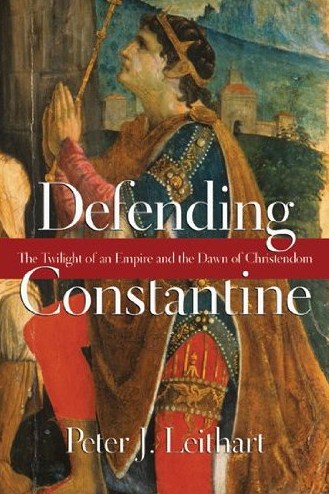
Defending Constantine: The Twilight of an Empire and the Dawn of Christendom by Peter J. Leithart
IVP Academic 2010
Rating: 8
Readability: 7
Impact: 8
Read it Again: At least portions.
Recommend It: Yes.
What to Expect
Defending Constantine is organized somewhat like a backwards Against Christianity. The first portion sorts through history and what accounts we have of the times of the early church, before, after, and during the reign of Constantine.
The entire book is theologically grounded and continually shows the tension and relation of Church and State. Many portions read like an essay or thesis against writers and thinkers like John Howard Yoder. Other sections are simply history with thoughts from an open Bible.
Defending Constantine is a history lesson, argument, and theological discussion wrapped up in a fascinating character and time in history.
A few sections may take some persistance, but the whole book is well worth the read and is organized with typical Leithart clarity and infused with scattered humor.
My Squib
I didn't know near as much as I wanted to/needed to about this era of history, so I was delighted with this book.
The scale of research, quotes, and organization alone was an impressive feat. Dr. Leitart attacks hard questions and arguments while looking through a wide scope of history and constantly referring to the Bible.
I am perpetually confused about what the relation of church and state should be and he addresses this even more in Defending Constantine than in Against Christianity.
The book gave an extended lesson on how theology, even minor ideas, affects the outworking of much of what we do. I found the discussion on pacifism particularly intriguing.
Dr. Leithart's arguments against John Howard Yoder are an interesting look into debate and thinking. By the end of the book, he has turned most of Yoder's arguments against Yoder himself.
This book was perfect for me on a number of levels, but it was well worth the time for the early church history alone.
Don't expect heroes to be perfect. But when imperfect people bow the knee to Christ, they can do great things...and who knows the consequences.
From the Book
"The church is a polity, and thus any ethical or political system that minimizes or marginalizes Jesus and his teaching hardly counts as Christian."
"In the end it all comes round to baptism, specifically to infant baptism. Rome was baptized in the fourth century. Eusebian hopes notwithstanding, it was not instantly transformed into a kingdom of heaven. It did not immediately become the city of God on earth. Baptism never does that. It is not meant to. Baptism sets a new trajectory, initiates a new beginning, but every beginning is the beginning of something. Through Constantine, Rome was baptized into a world without animal sacrifice and officially reognzized the true sacrificial city, the one community that does offer a foretaste of the final kingdom. All baptisms are infant baptisms.
Tuesday, August 23, 2011
Radical Together - David Platt
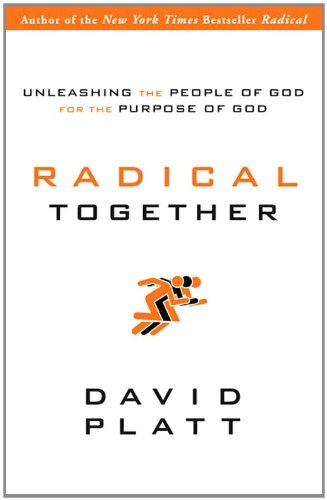
Multnomah (2011)
Rating: 8
Readability: 8
Impact: 9
Read it Again: Yes.
Recommend It: Yes!
What to Expect
Pastor David Platt moves from his best selling book, Radical, focusing on our own ambitions and expectations, to Radical Together, a book that focuses on the position, responsibility, and power of a community of believers.
Radical Together is a call back to a Christ-centered vision for the Church--her energy, resources, and focus.
The book focuses on both home-based discipleship and missions abroad, in a manner modeled after the Gospel.
David Platt is direct and engaging. He doesn't smooth over the tough stuff. If you aren't prepared to be convicted or spend time in serious evaluation, don't read this book.
My Squib
Radical Together draws its arguments and conclusions from the character of God and the fallen state of Man. The Church is a body of sinful, messed up, complicated people...all wrong for this beautiful, momentous task, but together created for a weapon of victory.
We are called to be selfless followers of a self-centered God. He is not our slot machine. We are His servants. There is no greater joy than serving, glorifying, and enjoying Him as He has called us!
A book taking the Church this seriously is both refreshing and somewhat depressing... We've been doing a pretty rotten job.
Both of David Platt's books have given me a lot to think about and evaluate in my own priorities and attitudes. They are dangerous stuff. I'd love to talk to someone else who has read them and has another take.
They've been my book of choice to give away for 2011, but I guess I still haven't decided what I think on all their aspects. Time for a reread... If only there wasn't so much else to read too! ;-)
From the Book
"Are these steps radical in and of themselves? For some the answer has been yes. For others, the answer has been no. But for all, the aim has been to set our lives and our churches in motion by putting ourselves in positions where God can mold our hearts with his gracious Word for his glorious purpose."
Monday, August 22, 2011
The Radical Reformission - Mark Driscoll

Zondervan 2004
Rating: 6
Readability: 8 (as long as you don't mind PG-13 content)
Impact: 7
Read it Again: Probably not, but got some good notes.
Recommend It: Maybe
What to Expect
Pastor Mark Driscoll tries to answer the question of open evangelism without compromise. He raises a lot of excellent questions and brings interesting facts and observations into discussion, but failed to give me a satisfying answer to the challenge.
His style is interesting and engaging but he goes beyond PG-13 sometimes. The world is a sticky, dirty place, and I don't mined some honesty and grime if it's to a point. In Radical Reformission, it seems like Pastor Driscoll is simply being earthy to prove that Christians can be earthy.
Overall the book is a interesting look into evangelism and how we've tangled ourselves. There is certainly plenty of wisdom and insight anyone can learn from.
My Squib
This book was good. I guess my main beef with it was on its view on the relationship between Gospel, the Church, and culture. He starts the book with this diagram in the introduction--

I could be just grossly misunderstanding this, but he does try to explain. I think culture/church will always be a complicated problem, but it seems like culture should flow from the worship as community of believers. His general lack of acknowledgement of the Church was a strain for me through out the whole book.
Here is a very un-techno diagram of what seems like a more natural/direct order of things.

This is big topic and I certainly know I don't have the answer, but Radical Reformission raised some questions that fascinated me.
I thought the book lacked a big picture look. Some of his answers and the Bible interpretations seemed overly simplistic. People are complicated and some of his answers just didn't allow for that.
Partly this book is older...in his recent sermons and writing I see a different flavor that seems much more like the wizened sage who's been battered a bit more with the stupidity of human nature.
I have learned a lot from Mark Driscoll and he has a lot of wonderful, insightful things to say. But if you're looking for a book on this topic I would recommend Radical and Radical Together by David Platt before picking up Radical Reformission. Pastor Driscoll is a stronger on home-based missions, but I left unsatisfied and still puzzling about
From the Book
"God desires to bless all nations and cultures of the earth through us, and so he has sent us into exile in places and among peoples no less strange or lost than the Babylonians. I would never have chosen Seattle as my place of ministry because it is one of the most politically liberal, expensive yet uncharitable, and least churched yet most self-righteous cities in the nation. But as Paul said on Mars Hill, it is ultimately God who has chosen my birthday and address, placing me in Seattle today (Acts 17:26). Likewise, where you live is a place of Babylonian exile where God has placed you to be about reformission. And it is incumbent upon you to be wise, faithful, and fruitful, like Daniel was, so that the gospel can take root in your Babylonian soil."
Tuesday, August 16, 2011
The Persecutor - Sergei Kourdakov
 The Persecutor by Sergei Kourdakov
Fleming H. Revell Co (1973)
Rating: 8
Readability: 8
Impact: 8
Read it Again: Yes
Recommend It: Yes. Everyone should read it.
What to Expect
Sergei Kourdakov grew up in communist Russia and became a KGB agent in the 1970s. He excelled in his position as passionate youth leader, student, and athlete by day and persecutor by night.
The Persecutor (also known as Forgive Me Natasha) is his story of disillusionment with the communist system and confusion with Believers in the face of death and hatred.
 My Squib
The Persecutor has no shinny turns of phrase or literary warm fuzzies, but it's written directly and honestly. It doesn't pretend to be anything more than the story of one man among thousands who suffered in Russia. Painful, powerful, and beautiful.
Kourdakov was shot only months after the book was finished. This is his true testimony to the world and his petition for forgiveness to the many Believers he persecuted. His prose is full of honor and respect.
I was pathetically ignorant of this period of history, so I am so thankful to have read a memoir of this caliber.
What would I do in this situation? Every once in awhile this question terrifies me. Would I take it with grace? How mushy are we as American Christians? Do we remember that we stand on the blood of thousands and thousands of Believers who have taken death with bravery and grace? Around the world people continue to die because they will not let go of the Cross. Right now...as I type this. Do we remember?
Monday, May 2, 2011
Seeing and Savoring Jesus Christ - by John Piper

Seeing and Savoring Jesus Christ by John Piper
Crossway Books 2004
Rating: 6
In this book soley focused on knowing Jesus, John Piper studies various Scriptures and expounds on different names and attributes. He delves into the character of Christ as portrayed in the entire Bible while ending each chapter with a written prayer.
Seeing and Savoring Jesus Christ is an excellent and beautiful study that brings you straight to the core of the Gospel and will make you think about our awe-inspiring God.
Yes, we must see and savor the character of Christ, but what does that mean about our character? Do we act like our Savior is all powerful, wise, merciful, just, selfless, and most of all, alive and reigning?
Overall it is a helpful study, but certainly not all inclusive. I certainly have much I can learn from it...
Thanks for reading,
Miss Pickwickian
Friday, April 29, 2011
The Cross Centered Life - C. J. Mahaney

C. J. Mahaney brings Christianity straight back to the cross.
We often ignore the wonder and finished work of Christ’s crucifixion and resurrection with its power and implications.
The Cross Centered Life is dedicated to shifting our focus back on that most important truth. The book starts by restating the obvious and then moves through chapters on the sin of legalism, the sin of holding onto our guilt and shame, our feelings vs. reality, and then offers practical ways to keep our thoughts and actions centered on Christ crucified and now risen!
The book is well organized and easy to read in very short moments or in one sitting. The style is clear and engaging, although I felt like he was a little overly imaginative and creative for the book he was trying to write.
I think he’s trying to reach a very broad audience, and I can see this being an excellent book for new as well as experienced Christians of a wide age range.
Miss Pickwickian
Saturday, April 23, 2011
The Seven Words on the Cross - A Hymn
| 1. Jesus, in Thy dying woes Even while Thy life-blood flows, Craving pardon for Thy foes: Hear us, holy Jesus. 2. Saviour, for our pardon sue 3. Oh, may we who mercy need 4. Jesus, pitying the sighs 5. May we in our guilt and shame 6. May our hearts to Thee incline, 7. Jesus, loving to the end 8. May we in Thy sorrows share, 9. May we all Thy loved ones be, 10. Jesus, whelmed in fears unknown, 11. When we vainly seem to pray | 12. Though no Father seem to hear, Though no light our spirits cheer, May we know that God is near: Hear us, holy Jesus. 13. Jesus, in Thy thirst and pain, 14. Thirst for us in mercy still, 15. May we thirst Thy love to know; 16. Jesus, all our ransom paid, 17. Save us in our soul's distress, 18. Brighten all our heavenward way 19. Jesus, all Thy labour vast, 20. When the death shades round us lower, 21. May Thy life and death supply By Thomas B. Pollock, 1870 |
Friday, April 22, 2011
Every age and hour

Monday, April 11, 2011
God Is - by Doug Wilson

God Is: How Christianity Explains Everything by Douglas Wilson
Miss Pickwickian
Thursday, March 31, 2011
Who are You? - Guest post elswhere

Miss Pickwickian
Thursday, March 24, 2011
Persuasions - Doug Wilson

Persuasions: A dream of reason meeting unbelief
If we try to persuade belief in Christ on merely an emotional basis, we deserve to be laughed at. We must know that what we believe is true. Surely this is part of the meaning of 1 Peter 3:15. Persuasions is a tool towards that end.
Certainly an easy group-read, extra Bible time activity, highschool assignment, or quick individual read. It started some interesting discussion in our house.
Down-to-earth honesty that brings ideas we often think unimportant into the realm we think and breathe everyday.
Here is one from Evangelist that I thought was particularly interesting-
Miss Pickwickian
Tuesday, March 22, 2011
Genocide
Miss Pickwickian
Tuesday, March 15, 2011
Not Immediately Pleasing to my Nature
....If it is I who determine where God is to be found, then I shall always find a God who corresponds to me in some way, who is obliging, who is connected with my own nature.
But if God determines where he is to be found, then it will be in a place which is not immediately pleasing to my nature and which is not at all congenial to me.
This place is the Cross of Christ. And whoever would find him must go to the foot of the Cross, as the Sermon on the Mount commands. This is not according to our name at all, it is entirely contrary to it. But this is the message of the Bible, not only in the New but also in the Old Testament…
~From a letter by Dietrich Bonhoeffer to his theologically liberal brother-in-law, Rudiger Schleicher.
Friday, March 11, 2011
The Four - Peter J. Leithart

The Four: A Survey of the Gospels by Peter. J. Leithart
Readability: 8
Some of it might seem a bit slow when he's getting into scholars arguments on dating etc... Why can't biblical scholars just believe the Bible? Most of it is extremely interesting and it continues to get more and more exciting as the book progresses.
That is the message of the final act of this romantic comedy. Yahweh comes in flesh; Israel's Father comes as Israel's Son, and He is rejected yet again. He is rejected more thoroughly than ever. Persecuting prophets is bad; killing God Himself is worse. But the resurrection shows that Israel's God will not let Israel have the final word. He will not let Israel's rejection stand. He keeps coming back, even after Israel thinks they have killed Him. Israel does her worst: Yahweh comes as man, and Israel kills Him. If this were not the gospel, it would be a horror story, because this God cannot be stopped, cannot be buried. He comes back, and back again, even from the grave.
Miss Pickwickian
Friday, February 18, 2011
We can Boast

Saturday, January 8, 2011
To Lose Everything


His course, obedience-- the only course that could lead to the fulfillment of his aim. His end was what some would call an extraordinary death, although in facing death he had quietly pointed out that many have died because of obedience to God.