Showing posts with label the idea of story. Show all posts

Wednesday, January 2, 2013

Les Miserables (2012)


Les Miserables is a beautiful story and has withstood many interpretations and productions. Somehow, even with the disturbing zeal to bury the story of redemption in the 1998 previous feature film, by Billie August and Rafael Yglesias, it retained portions of the thrilling hope of Victor Hugo's 1,500 page novel.

It is the musical, however, that took the story and shamelessly dug out the themes and belted out the epic of grace and forgiveness across 42 countries in 21 languages. Last year marked the 25th anniversary. A new live performance traveled through Cinemas and a breathing cast appeared in concert halls throughout England and the US. Tom Hooper was working on his mountainous task--turning the well-beloved musical into movie. Something that would explain and present the story to thousands who'd never heard it, as well as die-hard, jealous fans. He is pretty crazy.


The finished product exploded on Christmas Day. Tom Hooper and our grand knight, Sir Cameron Macintosh, once again proved themselves (above and beyond Peter Jackson and other ambitious individuals who seize a powerful story in new love and best intentions and flail to present it to the public, missing and mutating the very elements that probably attracted them...ahem. We still love them anyway).


This new musical movie of Les Miserables presents the story in all of its gritty, offensive love, grace, and hope. With melody, words, and screen, the movie is able to highlight and draw out the beautiful symbolism and themes, something many of us haven't trained ourselves to do on our own. You forget you're in a musical and only find yourself in a grand epic which is, at the same time, the  personal story of each of us. This rendition was done in an adventurous way, all of the singing recorded during filming and on set, much of it straight at the audience. The factory women accuse us. Fantine begs us. There is no sparing our emotions or allowing us to hold it at arm's length--all the grit and the grace are right there, sometimes yelling, sometimes drawing us into the screen.


With all it's realism, it goes a little far, making the movie harder to enthusiastically recommend. As you could expect, the scenes with dissolutes and prostitutes lead to unnecessary content when performed as a complete screenplay. There is at least sixty seconds that none of us needed, even if it jolts us out of our comfortable, clean ignorance or indifference to things occurring today in our own cities...


Anne Hathaway gives everything she has to her performance of Fantine and left me absolutely speechless. Even if you are a Hathaway hater (which I have been) you have to admire how much of herself she pours into this character. Yeah...still pretty speechless on this.


Hugh Jackman also dug into his role. If you cringe at his voice at the beginning, it is because he starved himself to look and feel more like a laboring convict for the first shot. He improves over time and while there have been better voices, I whole-heartedly adore his Jean Valjean (even if you dread "Bring Him Home"). His soliloquy and last scene sacrifice things that can very well be sacrificed to bleed all the soul and life and struggle and longing. Outstanding.


But even with all his superb acting, Hugh Jackman is not Colm Wilkinson, so for dedicated Les Miserables fans, Wilkinson's appearance as the Priest is both exciting and satisfying. It also gloriously draws out how, through the Priest's kindness, Jean Valjean turns and becomes like the Priest. How Christ sacrifices and cares for us--recreates us into little Christs becoming more like Himself, and sends us out to show His Character and grace to the world.


Also this should comfort Les Miserables zealots and please Colm Wilkinson fans.


Aside from the live performance, Aaron Tveit was the best Enjolras I've seen. He probably didn't have the best voice, but all his vibes were spot on. I fell in love with the whole revolution preparation scene in a completely new way. His life and complete character--how it was contrasted and shown against others and how he inspired and loved his brothers, may have been my favorite and freshest part of the movie. Some may say his end was a little over the top, but if you dig into many historical biographies, you can find that many endings are similarly over the top and ridiculously epic.


Marius was a great rich kid. Cosette, despite deep-rooted loathing for Amanda Seyfried, may have been my favorite interpretation yet. Both seemed appropriately unlikable and newbish at the beginning but hopeful characters by the end. They were presented as I saw them in the story.


Although Eddie Redmayne's voice does not reach godlike status (who can compare with Micheal Ball?), his "Empty Chairs and Empty Tables" is acted and sung in a way to wring your heart.


I'd seen Samantha Barks as Eponine before, but this screen version made me sympathize and fall in love with the character for the first time. And, unlike much of the cast, I have no hesitations about her voice.

The true test came with Javert. My first introduction to the Les Miserables musical came from Philip Quast version of Javert's soliloquy. It instantly rocked my world and has continued to do so ever after. The character of Javert created my original love and devotion to the story many years before and has probably influenced me above and beyond just my writing.


All my backstory with the Inspector made Russell Crowe's performance imperative to any joy or horror I would get out of the movie. His first singing attempt actually was a little distressing. He improves over time and does interesting interpretations of his two solos. His acting is phenomenal and I feel like he really entered into the character and understood him. His performance is almost as opposite to Norm Lewis as anyone with the same lines can present. Russell Crowe paints a more passive character with considerably less gleeking and more unspoken conflict. He is a little soft, in all respects, but I actually loved his embodiment of so complex a character. Of course, he is not the only right and perfect portrait and his voice, even with everything else he adds to the character, is nothing exceptional and still cannot be compared to Philip Quast.


The scene right before Javert starts his soliloquy was disappointing. They switch it up so Jean Valjean leaves basically in defiance (also, covered in a little too intense of sewerness). I understand how this might have made the scene switches and all easier, but it was almost an unforgivable sin.
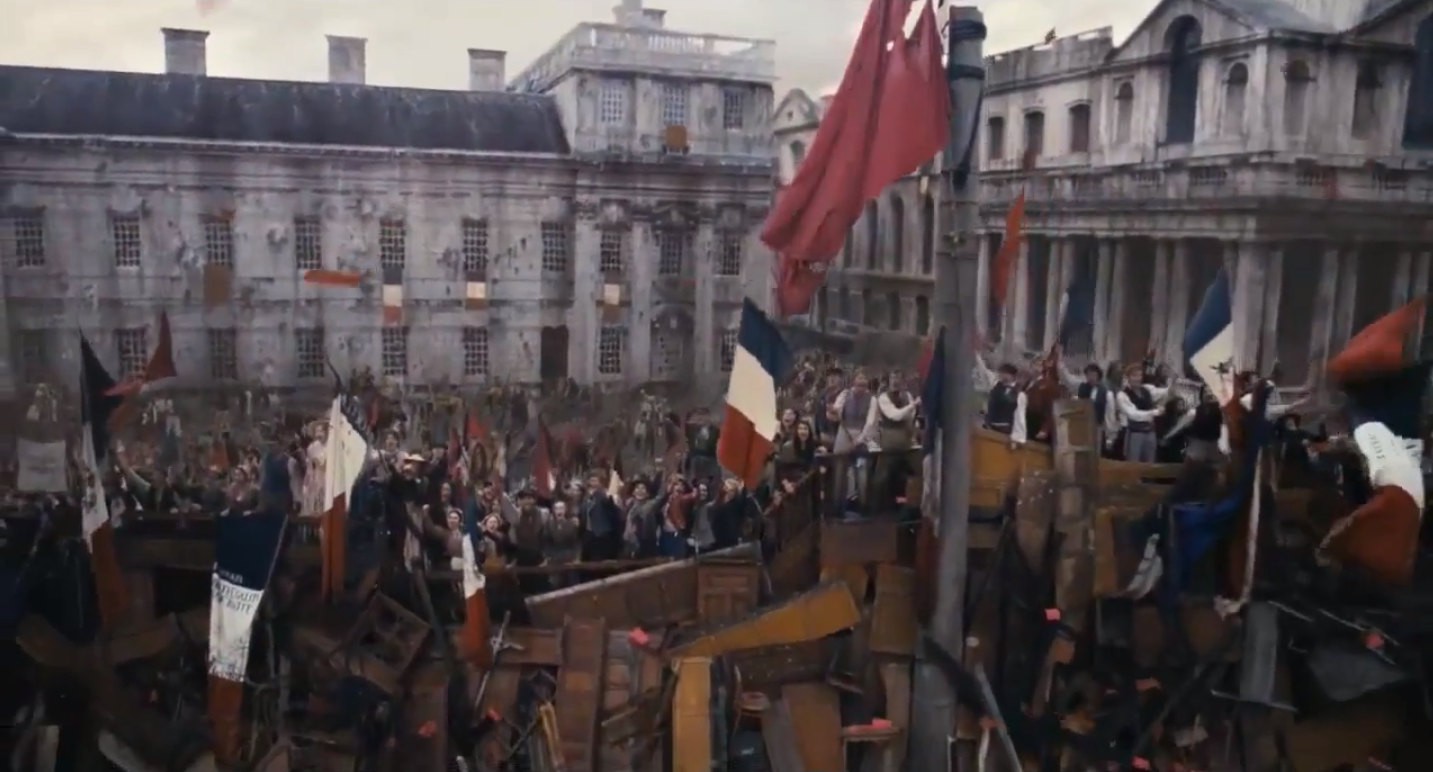

The only other dissatisfying scene for me was the end. Although when you learn the history, the last scene makes more sense, even a successful revolution hardly gives Fantine, Gavroche, or Valjean the hope and deliverance they need and long for. This finale piece is much bigger and seemed trivialized and disconnected from the thirst we all have and the song of victorious hope in the souls of all who have been driven to the light. A disappointing scene to finish a glorious story. But perhaps if they'd wrapped it up in all it's heart-throbbing glory no one would have been able to walk out of the theater alive.


Of course there are portions left out and others jumbled. There is a new song and theme added written by the original creators who were all involved with the movie. The new content highlights Jean Valjean and Cosette's father/daughter relationship. It feels almost Disneyish in a few moments, but gives a break from the intensity of the rest of the movie. I already had mountainous respect for Tom Hooper and now it will last forever. What a massive task to turn a successful musical into a cohesive, powerful screenplay. The hard work and dedication by the entire cast and crew is unbelievable.


There will be more Les Miserables, some which will perhaps dig deeper and soar higher, but this movie captures the spirit, raw soul, and devastating grace. The best stories can and should be told in many ways, shapes, and forms. If you can deal with the grit or know when to go get a popcorn refill, go see it.

Come back and tell me what you think. :-)

There is so much more that can be said. Hopefully Lauren will say some of it soon. If you go see it, look for crosses (obvious and camouflaged), new creation/covenant and old world/covenant themes, reoccurring musical melodies, and contrasting reactions and characters.

Also see this post - Comfort and Confrontation for us Les Miserables Snobs


Artists be encouraged. Work done this well and with such a proclamation of truth will last, spread, and send tremors throughout the world. We are changed by just such things as these.

Friday, January 7, 2011

Threw New Eyes - James B. Jordan


Through New Eyes: Developing a Biblical View of the World by James B. Jordan
Wolgemuth & Hyatt, Publishers Inc (First printing 1988)


This is a book I've heard about a lot but never read. It was a much easier read than I first anticipated and I really enjoyed it. I wish it was something I'd done a long time ago.


I've never actually read anything by Jim Jordan (besides a few articles) so it was pretty interesting after hearing hours of his lectures. His voice was pretty stuck in my head.

I think Through New Eyes really helped me see better where he and a lot of other writers and teachers are coming from...more of the root of it, you know. It was really an exciting read.

He goes through the Biblical "worlds" and covenants and points out imagery and symbolism that really hit you on the head and make you think. It is a quick but invaluable overview from Genesis to the church today.

Besides the fact that we want to see the world biblically and see the Bible biblically, I found this book really exciting when it comes to trying to write fiction in a way that portrays accurately God's world.

Recently I've been going through a series of lectures on The Church and Pop Culture. In one of the talks N.D. Wilson says that all fiction would be plagiarism if we weren't so bad at it. And we are miserably bad at it. I don't know if the connection makes sense, but it did to me at the time... :-)

Here are just two portions that I thought were particularly interesting-

What emerges from this discussion is that if we want to acquire a Biblical view of the world, we shall have to make a study of Biblical symbolism. The way the Bible uses symbols shows us how to interpret God's natural revelation.

The Jews of this period had almost completely perverted the law. As we have seen, they were not keeping the moral requirements of the law. Neither did they understand the symbolic aspects. When Jesus told the Jews that if they destroyed the Temple He would raise it up in three days, referring to His body, they were utterly confused (John 2:19-21). Similarly, when Jesus talked with Nicodemus and referred to the water-cleansing rites of the Old Covenant as a means of resurrections and new birth, Nicodemus was confused. Jesus expressed amazement: "Are you the teacher of Israel, and do not understand these things?" (John 3:10).
In the first century, the Jews had rejected Biblical symbolism and typology, and were divided into two groups. The Pharisees had turned symbolism into moralism, and were keeping the law as a means for salvation. The Alexandrian Jews had replaced Biblical typology with allegories grounded in Greek philosophy. As a result neither group was able to recognize Christ when He came to them.

Basically Through New Eyes is amazing and should be a must-read.

I have the feeling that the books I love and admire the most are the ones that get the crummiest reviews... Something I need to work on. But in one sense I just don't feel qualified and I'm not sure what I should add. You should read it. :-)

Thanks for reading,
Miss Pickwickian


Tuesday, October 26, 2010

Deep Comedy - Peter J. Leithart


Deep Comedy: Trinity, Tragedy, & Hope in Western Literature by Peter J. Leithart
Canon Press


This is another book I am totally unqualified to review. I'm going to try anyways because I want you to be inspired to read it. (If you haven't...I know I'm always shamefully behind.:-)
It's quite simply amazing.


We had a wonderful Sunday school class talking through David Bentley Hart's book on beauty. Deep Comedy was mentioned and I knew I wanted to read it. :-) I have an awesome mama and a brother who works at a book store, so it was diligently acquired. Thanks Mama! I know your going to like it as soon as you get done with Notes from the Tilt-A-Whirl...already. ;-)

This book was both easier and harder than I anticipated.
Easier because Leithart is a gifted and hard working genius and can make the difficult clear and direct so people like me can understand.
Harder because I'm not very sharp and don't know very much about many of the people and stories he mentions.
Still, I could understand the concepts he was writing, even if I didn't always understand the people he was quoting or arguing against. I never felt completely lost, just vaguely stupid.

I loved the book. It wasn't a hard read. I read all but the last 10 pages in two sittings and I'll want to read it again.
It's direct and eye opening. It is laced with good humor (I literally LOLed in several parts). It is a book about story and about hope. By the end I was feeling disgustingly cheerful. :-) It was amazing.

Since I know I'll fail at trying to paraphrase I strongly suggest you pick the book up yourself. It's only 157 pages. Anyone can manage that.
Leithart crams a lot in. I really can't begin to summarize. He gave me a whole new dimension to understanding the way our faith in the Trinity shapes our world view. He gave me a clearer understanding of story and all that goes along with it. It was simply thrilling. :-)
I know I'm raving now, so I'm going to move on.

Here are two of my favorite quotes...

"If the Gospel is true, if new life was unleashed in the world on Easter morning, then we would expect there to be some signs that this is the case."

Unleashed. I love that. How often do we think of new life as unleashed?

"Satan digs a pit for the merry, but Satan falls into the very pit of merriment. And it tortures him forever."

And here was a quote that really got me thinking...

"Christian literature not only produces deep comedy but also, and for precisely that reason, deep tragedy. Christian tragedy can no longer mean what ancient tragedy meant. There are still sad stories, but Christians cannot believe the world is a sad story without abandoning their fundamental convictions about the triune God and the incarnation of the Son. So I should add to this book a companion book on deep tragedy."

I hope he does.

I particularly liked what he said about Christian tragedies. It seems like too much modern Christian thinking tries to ignore sad stories because it spooks them. We know that life isn't a tragedy but sometimes we can't understand why tragedies happen. We try to ignore them so we write fuzzy feel good fiction or try to shelter ourselves from reality.

He also mentions in passing that many "Christian" tragedy's are even sadder because there was an unrealized hope of redemption.

This helped me understand myself in relations to The Mayor of Casterbridge. I'm not sure where Thomas Hardy was when he wrote it. I know he was bi-polar when it came to his "faith" but I think the movie gives an interesting interpretation. It is so extremely sad because there was hope of redemption. He could have turned around.
Like Saul, which he resembles, Henchard is given a good life (numerous times) and good friends, but because of his sin and pride he will not repent and be reconciled. And it's absolutely, terribly heart rending!
The story is not meaningless. It is not a story meant to depress you. It shows the stupidness of sin. The depravity of man. But also the mercy of God. Henchard is blessed over and over again, he just never gets it.
And in the end the long-suffering daughter gets a good life with a righteous man (whatever is ultra-weird, irrational behavior towards woman comes in).

My conclusion seemed to be this-- Christian stories can be sad (even sadder then non-Christian) but they can not be ultimately depressing.
I know I'm not explaining this very well, but it helped things line up in my mind...

Okay, one last quote (sorry about the longness, but it's worth it).

"The conclusion of the matter is this: for the ancients, for the moderns, and for postmoderns, human existence is fundamentally tragic. The world is built for tragedy. As a matter of sheer observation, we all die, and this is one of the few things that can be guaranteed about life. Time marches toward death and in the end we all die. Change can perhaps be good, but change is ultimately decay, because in the end we all die. Desire is either fulfilled in the motionless statis that might as well be death, or is never fulfilled leaving us frustereated, and in the end we all die. Law gives a semblance of order to the process of decay and the forces of chaos, but law is uncertain, and in the end we all die.
With their tragic narratives of human history, Hesiod and Ovid give mythical expressions to the story of the world that ancient, modern, and postmodern all tell.
Apart from the Gospel, what other story is there?"

I consider this book invaluable to readers, writers, and Christians.

Now, if you haven't, go read it. :-)

Thanks for reading.
Miss Pickwickian

Monday, October 4, 2010

A House for My Name - Peter Leithart


A House for My Name: A Survey of the Old Testament by Peter J. Leithart
Canon Press


There is no way I can really review this book.
That it can encompass such a understandable and exciting survey of the Old Testament in itself is amazing. I love Leithart's direct and concise writing.


I believe our Sunday school curriculum is based of this book and I've also read it before, but I picked it up again a couple weeks ago. I'm in 1-2 Kings right now in my Ligonier course and the commentary book isn't my favorite. It seems very narrow and doesn't pull or connect to any other part of the Bible. I felt like I needed something supplementary, so I picked A House for My Name. I'm extremely glad I did. :-)

I feel like it's something I should read bi-annually, since I'm not smart enough to remember all its amazingness!

It's one of those books that really makes you want to become wiser while showing you how horribly insufficient your mind is. (At least that's the way it made me feel...in a good way, of course. Does any of that make sense?)

I'm going to have fond memories of reading it too. I took it outside on a couple of occasion and read while I was swinging (sorry if that sounds childish). I love September and September wind should not be wasted. And, I finished on a Sunday afternoon accompanied by blackberry wine. ;-)

If you haven't read it, here's just a couple quotes to prick your appetite...

"The Bible tells one story.

It is a long and complicated story about events that took place over several thousand years, but even so it is one story. Like most good stories, the most exciting and important parts come toward the end.
In this case, the most important part comes when Jesus is born, lives, dies on the cross, rises again, and ascends to heaven. But to know why Jesus comes and what He is doing when he dies and rises again, we need to know the story that goes before. A man kisses a sleeping woman in a wood and she awakes. That's a nice ending to a story, but if we don't know that the woman is Sleeping Beauty and the man is Prince Philip, then we don't know the story very well.

A beginning is nothing without an ending, but an ending without a beginning isn't worth much either. To tell the story of Jesus, we need to start with Genesis, the first book of the Bible, a book whose name means 'Beginnings'. "


"Destroy this temple, Jesus said, and in three days I will raise it up. Three days later, Jesus is raised. But the water flowing from His side shows that Israel will be raised with Him and built into the new temple of His body.
In Pilate's Praetorium, the Jews renounces Jesus, choosing death over life.
But the Israel of God is never dead for long.
Israel has died before--in the wilderness between Egypt and Canaan, during the time of the judges, during the reign of Ahab, at the Babylonian exile. But when Old Israel dies, Yahweh, the Lord of life, brings a New Israel from the grave.

The death and resurrection of Jesus, who is the true Jacob and Israel, who is the temple flowing with living water, is the sign that a New Israel will be born. The Jews have rejected their king and destroyed their temple, but out of their dead bones the Spirit brings forth living stones for the holy house, an army that cannot be numbered.

But that is another story."


On a side note (being obsessed with "story" and writing as I am) I found this book very inspirational. To see and try and understand how the great Author creates the perfect story is awe inspiring.

Thanks for reading,

Miss Pickwickian

Wednesday, August 18, 2010

A Thousand Miles in a Million Years - Donald Miller


A Thousand Miles in a Million Years: What I Learned While Editing My Life by Donald Miller
Thomas Nelson, Inc


Rating: 9
Readability: 9
Impact: 10+


Read it Again: Yes, again and again
Recommend it: Yes! Go buy it here. Right now.


What to Expect

Donald Miller uses the concept story to show us the changes in life and in ourselves, while inspiring us to create an epic.

Even if you didn't like Blue Like Jazz you should give this one a try. Especially if what bothered you about his first book was its rambling, style, or "peace-loving" issues. Of course in my opinion Blue Like Jazz was totally awesome. ;-)

My Squib

This book resonated with me on every level.
What could be more awesome for a wanna-be-author then an amazing word smith directly applying the idea of Story to everyday life?

This is an amazing quick read that really helps you dig down and think.

His style is heart warming and honest. I seriously was teary eyed through the last 100 pages.

My only complaint is his need for a better proof reader...

(His writing is sometimes a little too 'honest' and/or borderline. Because of this I think its more directed towards 14+, but it certainly has principles that apply to everyone.)

Basically, a must read. :-)

Read Polka Dot's thoughts on A Million Miles in a Thousand Years here.

Thank you again, Ellen, for "introducing" me to Donald Miller! You are an awesome friend.

From the Book

I seriously copied so much of this book into my journal! Here is just enough to whet your appetite...

"The thing about trying to remember your life is it makes you wonder what any of it means. You get the feeling life means something, but you're not sure what. Life has a peculiar feel when you look back on it that it doesn't have when you're actually living it."

"Somehow we realize that great stories are told in conflict, but we are unwilling to embrace the potential greatness of the story we are actually in. We think God is unjust, rather than a master storyteller."

"I believe there is a Writer outside ourselves, plotting a better story for us, interacting with us, even, and whispering a better story into our consciousness."

"It wasn't necessary to win for the story to be great, it was necessary to sacrifice everything."

"It's interesting that in the Bible, in the book of Ecclesiastes, the only practical advice given about living a meaninful life is to find a job you like, enjoy your marriage, and obey God. It's as though God is saying, Write a good story, take somebody with you, and let me help."

"We live in a world where bad stories are told, stories that teach us life doesn't mean anything and that humanity has no great purpose. It's a good calling, then to speak a better story. How brightly a better story shines. How easily the world looks to it in wonder. How grateful we are to hear these stories, and how happy it makes us to repeat them."