Showing posts with label history. Show all posts

Wednesday, September 7, 2011

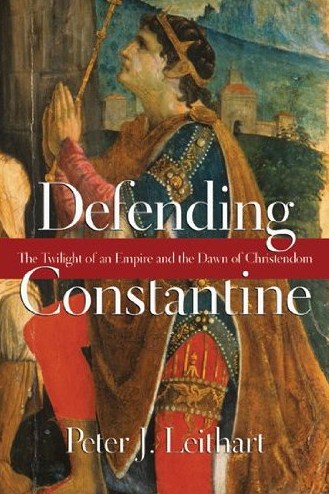
Defending Constantine - Dr. Peter Leithart


Defending Constantine: The Twilight of an Empire and the Dawn of Christendom
by Peter J. Leithart
IVP Academic 2010


Rating: 8
Readability: 7
Impact: 8


Read it Again: At least portions.
Recommend It: Yes.


What to Expect


Defending Constantine is organized somewhat like a backwards Against Christianity. The first portion sorts through history and what accounts we have of the times of the early church, before, after, and during the reign of Constantine.

The entire book is theologically grounded and continually shows the tension and relation of Church and State. Many portions read like an essay or thesis against writers and thinkers like John Howard Yoder. Other sections are simply history with thoughts from an open Bible.

Defending Constantine is a history lesson, argument, and theological discussion wrapped up in a fascinating character and time in history.
A few sections may take some persistance, but the whole book is well worth the read and is organized with typical Leithart clarity and infused with scattered humor.

My Squib


I didn't know near as much as I wanted to/needed to about this era of history, so I was delighted with this book.

The scale of research, quotes, and organization alone was an impressive feat. Dr. Leitart attacks hard questions and arguments while looking through a wide scope of history and constantly referring to the Bible.

I am perpetually confused about what the relation of church and state should be and he addresses this even more in Defending Constantine than in Against Christianity. 

The book gave an extended lesson on how theology, even minor ideas, affects the outworking of much of what we do. I found the discussion on pacifism particularly intriguing.


Dr. Leithart's arguments against John Howard Yoder are an interesting look into debate and thinking. By the end of the book, he has turned most of Yoder's arguments against Yoder himself.


This book was perfect for me on a number of levels, but it was well worth the time for the early church history alone.

Don't expect heroes to be perfect. But when imperfect people bow the knee to Christ, they can do great things...and who knows the consequences.

From the Book


"The church is a polity, and thus any ethical or political system that minimizes or marginalizes Jesus and his teaching hardly counts as Christian."


"In the end it all comes round to baptism, specifically to infant baptism. Rome was baptized in the fourth century. Eusebian hopes notwithstanding, it was not instantly transformed into a kingdom of heaven. It did not immediately become the city of God on earth. Baptism never does that. It is not meant to. Baptism sets a new trajectory, initiates a new beginning, but every beginning is the beginning of something. Through Constantine, Rome was baptized into a world without animal sacrifice and officially reognzized the true sacrificial city, the one community that does offer a foretaste of the final kingdom. All baptisms are infant baptisms. 

Tuesday, August 16, 2011

The Persecutor - Sergei Kourdakov

The Persecutor by Sergei Kourdakov
Fleming H. Revell Co (1973)


Rating: 8
Readability: 8
Impact: 8


Read it Again: Yes
Recommend It: Yes. Everyone should read it.


What to Expect

Sergei Kourdakov grew up in communist Russia and became a KGB agent in the 1970s. He excelled in his position as passionate youth leader, student, and athlete by day and persecutor by night.

The Persecutor (also known as Forgive Me Natasha) is his story of disillusionment with the communist system and confusion with Believers in the face of death and hatred.

My Squib

The Persecutor has no shinny turns of phrase or literary warm fuzzies, but it's written directly and honestly. It doesn't pretend to be anything more than the story of one man among thousands who suffered in Russia. Painful, powerful, and beautiful.

Kourdakov was shot only months after the book was finished. This is his true testimony to the world and his petition for forgiveness to the many Believers he persecuted. His prose is full of honor and respect.

I was pathetically ignorant of this period of history, so I am so thankful to have read a memoir of this caliber.


What would I do in this situation? Every once in awhile this question terrifies me. Would I take it with grace? How mushy are we as American Christians? Do we remember that we stand on the blood of thousands and thousands of Believers who have taken death with bravery and grace? Around the world people continue to die because they will not let go of the Cross. Right now...as I type this. Do we remember?

Monday, March 7, 2011

What I've been studying all week...


King Henry V a the Battle of Agincourt, 1415
by John Gilbert (1817-1897)

"The mirror of all Christian kings."
?

What do you think Shakespeare was trying to say?

Thanks for reading,
Miss Pickwickian


Saturday, January 8, 2011

To Lose Everything


Today it is 55 years.

He is no fool who gives what he cannot keep to gain what he cannot lose.


Here is a quote from the introduction of Shadow of the Almighty by Elisabeth Elliot--

Jim's aim was to know God.
His course, obedience-- the only course that could lead to the fulfillment of his aim. His end was what some would call an extraordinary death, although in facing death he had quietly pointed out that many have died because of obedience to God.
He and the other men with whom he died were hailed as heroes, 'Martyers'. I do not approve. Nor would he have approved.
Is the distinction between living for Christ and dying for Him, after all, so great? Is not the second the logical conclusion of the first? Furthermore, to live for God is to die, 'daily', as the apostle Paul put it. It is to lose everything that we may gain Christ. It is in thus laying down our lives that we find them.

Thanks for reading,
Miss Pickwickian

Wednesday, August 18, 2010

From Paradise to Promise Land - T.D. Alexander


From Paradise to Promise Land: An Introduction to the Pentateuch by T. D. Alexander
Second Edition, Baker Academic and Paternoster: Thinking Faith


Rating: 8
Readability: 8
Impact: 8

Read it Again: Maybe the second section, yes.
Recommend It: Yes


What to Expect

Alexander's book is divided into two sections, Pentateuchal Criticism and The Main Themes of the Pentateuch.

Part 1: Pentateuchal Criticism deals with hypothesis on who wrote the Pentateuch, when it was written, and if it still applies.
I bogged down in this part. So many scholars arguing about the Bible when they don't even believe it. Probably important information...but pretty much a headache.
At first I was really wondering where he was going with it all. It kind of sounds like he's totally disregarding the fact that the Bible is the authoritative Word of God. His conclusion to Part 1, however, was well worth the slog threw the early pages.

Part 2: The Main Themes of the Pentateuch goes through Genesis-Deuteronomy discussing the main subjects and themes. I thoroughly enjoyed this section. After each chapter and theme discussion he would have a short section on New Testament Connections. I thought those sections were especially cool. :-)

T.D. Alexander is extremely well organized and understandable.

My Squib

This is the third book in my Ligonier course. Yeah! I'm making progress!

I really liked and learned from the second and largest section of the book.
While some of it was pretty basic, a lot of it helped me connect and think on a different level then before.

I also really enjoyed reading through all of the Pentateuch in a month. I confess I've never read through that section of the Bible that fast and it helped me put together Isreal's history as a whole much better.

From the Book

"The distinctiveness of the biblical laws is apparent when one compares the other ancient Near Eastern laws. In the earlier Laws of Hammurabi, a murderer is required only to make financial compensation to the victims family. This contrasts sharply with the biblical insistence of a life for a life. On the other hand, the non-biblical laws apply the death penalty to breaking and entering, looting at a fire, and theft. These examples reveal that in other cultures financial loss was sometimes treated more seriously than loss of life. The biblical laws consistently emphasis the human life is of greater value than material possessions."

"Holiness emanates from God; He is the sole sources of holiness. He alone endows other objects , places or people with holiness. Everything that is given to God or belongs to Him is holy."

"A natural extension of the belief that God is holy is the idea that holiness means wholeness or perfection. To be holy is to be unblemished or unmarred. It is to experience life in all its fullness as God had originally intended it to be."

"From the perspective of a Christian living in the twenty-first century AD these ancient writings continue to be highly relevant, especially given the NT proclamation that Jesus Christ is the son of Abraham and the son of David, who mediates God's blessing to all the nations of the earth."

Monday, July 19, 2010

Night - Elie Wiesel


Night by Elie Wiesel
Translated by Marion Wiesel

Hill and Wang


Rating: 10
Readability: The style is very readable, but the content is sometimes hard to read.
Impact: 9

Read it Again: Yes
Recommend it: Yes


What to Expect

A heart-rending, poignant memoir of a teenage boy during the holocaust.

This book is brutal in its portrayal of brutality.
It is certainly not for the faint hearted. It gets an R rating for violence, disturbing images, and some other material.
Having said that, it is not an inappropriate book. I highly recommend it. Some of it is disturbing, but it's subject matter is disturbing. To try to make it undisturbing would be unforgivable.

Elie Wiesel is now a best selling author of over 55 books. This is his first. His testimony to the world.


My Squib

I hardly know what to say about this book.

I feel guilty admiring his writing style (even after it has survived translation), but the truth is, its amazing. I was so struck by the elegant prose in the introduction that I read it three times and then immediately felt guilty for admiring it so much when it deals with the subject matter.

The main book text is not as fluid and amazing as the introduction, but his style fits perfectly with his story. It is heart wrenching and honest.

This is not a happy book, but I highly recommend it. There is much to learn from such a slim, 100 page volume.

One thing that did strike me was how far Jews have come from the OT even and how different everything would be without Christ. I would never have the stamina and will to continue living that this sixteen year old boy does if I did not have hope in Jesus.

I quoted a section of the forward by a French Christian who met the author before the book was written.
Wiesel, a reporter at the time, was conducting an interview with him on his reaction and memories from the war. Francois Mauriac, the French Christian, spoke of a memory of the eyes of starving Jewish children staring from a moving train car. Wiesel replied, "I was one of those children." Thus started their relationship.
Mauriac's reaction and wish for the Jews to have known and recognized Christ as Lord, spoke strait to me. You can see the quote below.

Please read the quotes. They say much more then I can.

From the Book

Okay, so I took a lot of quotes from this book. I wanted a piece of the intro because it was so beautifully profound. I took a piece of the forward because it took my emotions and thoughts towards this story from a Christian perspective and put them into better words. I took pieces from the book so you actually see what it was like. And I took pieces from Elie Wiesel's Peace Prize speech because he is so amazingly quotable. I do not necessarily agree with everything Wiesel says, but his views on indifference spoke right to me.

Please read the quotes. They will give you much more then my review can. Or, just pick up the book and read....

-From the introduction to the new edition-

"If in my lifetime I was to write only one book, this would be the one.
Just as our past lingers in the present, all my writings after Night, including those that deal with biblical, Talmudic, or Hasidic themes, profoundly bear its stamp, and cannot be understood if one has not read this very first of my works.
Why did I write it?
Did I write it so as not to go mad, or on the contrary, to go mad in order to understand the nature of madness, the immense, terrifying madness that erupted in history and the conscience of mankind?
Was it to leave behind a legacy of words, of memories, to help prevent history from repeating itself?
Or was it simply to preserve a record of the ordeal I endured as an adolescent, at an age when one's knowledge of death and evil should be limited to what one discovers in literature?
There are those that tell me that I survived in order to write this text. I am not convinced. I do not know how I survived: I was weak, rather shy; I did nothing to save myself. A miracle? Certainly not. If heaven could or would perform a miracle for me, why not for others more deserving than myself. It was nothing more than chance. However, having survived, I needed to give some meaning to my survival. Was it to protect the meaning that I set to paper an experience in which nothing made sense?
In retrospect I must confess that I do not know, or no longer know, what I wanted to achieve with my words. I only know that without this testimony, my life as a writer - or my life, period - would not have become what it is: that of a witness who believes he has a moral obligation to try and prevent the enemy from enjoying one last victory by allowing his crimes to be erased from human memory....

And yet, having lived through this experience, one could not keep silent no matter how difficult, if not impossible, it was to speak.
And so I persevered. And trusted the silence that envelops and transcends words. Knowing all the while that anyone of the fields of ashes in Birkenau carries more weight then all the testimonies about Birkenau. For despite all my attempts to articulate the unspeakable, 'it' is still not right....

Sometimes I am asked if I know 'the response to Auschwitz'; I answer that not only do I know it, but that I don't even know if a tragedy of this magnitude has a response. What I do know is that theres is a 'response' in responsibility. When we speak of this era of evil and darkness so close and yet so distant, 'responsibility' is the key word.
The witness has forced himself to testify. For the youth of today, for the children who will be born tomorrow. He does not want his past to become their future.

~Introduction to the New Translation by Elie Wiesel

-From the forward by Francois Mauriac-

"And I, who believe that God is love, what answer was there to give my young interlocutor whose dark eyes still held the reflection of the angelic sadness that had appeared one day on the face of a hanged child?
What did I say to him?
Did I speak to him of that other Jew, this crucified brother who perhaps resembled him and whose cross conquered the world?
Did I explain to him that what had been a stumbling block for his faith had become a cornerstone for mine.
And that the connection between the cross and human suffering remains, in my view, the key to the unfathomable mystery in which the faith of his childhood was lost? And yet, Zion has risen up again out of the crematoria and the slaughterhouses. The Jewish nation has been resurrected from among its thousands of dead. It is they who have given it new life.
We do not know the worth of one single drop of blood, one single tear. All is grace. If the Almighty is the Almighty, the last word of each of us belongs to Him.
That is what I should have said to the Jewish child. But all I could do was embrace him and weep."
~From the Forward by Francois Mauriac

-From the Book Text-

"The night was gone. The morning star was shining in the sky. I too had become a completely different person. The student of the Talmud, the child that I was, had been consumed in the flames. There remained only a shape that looked like me. A dark flame had entered my soul and devoured. it."

" 'I've got more faith in Hitler than anyone else. He's the only one who's kept his promises, all his promises to the Jewish people.' "

"I shall never forget Juliek. How could I forget that concert given before an audience of the dead and dying? Even today, when I hear that particular piece of Beethoven, my eyes close and out of the darkness emerges the male and melancholy face of my polish comrade bidding farewell to an audience of dying men."

"From the depths of the mirror, a corpse gazed back at me. The look in his eyes, as they stared into mine, has never left me."

-From Elie Wiesel's Nobel Peace Prize Acceptance speech 1986

"But I have faith. Faith in the God of Abraham, Isaac, and Jacob, and even in His creation. Without it no action would be possible. And action is the only remedy to indifference, the most insidious danger of all...

And I tell him that I have tried. That I have tried to keep memory alive, that I have tried to fight those who would forget. Because if we forget, we are guilty, we are accomplices.
And then I explain to him how naive we were, that the world di know and remained silent. And that is why I swore never to be silent whenever and wherever human beings endure suffering and humiliation.
We must take sides.
Neutrality helps the oppressor, never the victim. Silence encourages the tormentor, never the tormented.

~From the Nobel Peace Prize Acceptance Speech by Elie Wiesel 1986
Saturday, May 22, 2010

Too Late to Apologies: A Declarations

An amazingly done spoof! I actually love the song and the guys voice. Anyways, this made me LOL and I thought you all might need something light hearted for a Saturday. :-)

Wednesday, March 31, 2010

Thinking about World War II


I've had a fascination with World War 2 and the surrounding era for...well forever pretty much. (Probably comes from having three older brothers. :-) Anyways, I am so happy that I've finally decided to move my story in the 40s/50s era. It's giving me a good excuse to do lots of research and get in the mood. I wish we had womans clothing like World War 2 now! :-)

Anyways...just thinking about World War 2....
Miss Pickwickian

(Pictured above- Daniel Craig in Defiance 2009)